Home / Plywood manufacturing
How Plywood Is Made in a Vietnam Mill, Log to Sanded Panel
Ten stages turn a plantation log into a calibrated sheet. The glue, the press cycle and the sanding decide most of what you see on arrival. Knowing the stages tells you what to write in the specification.
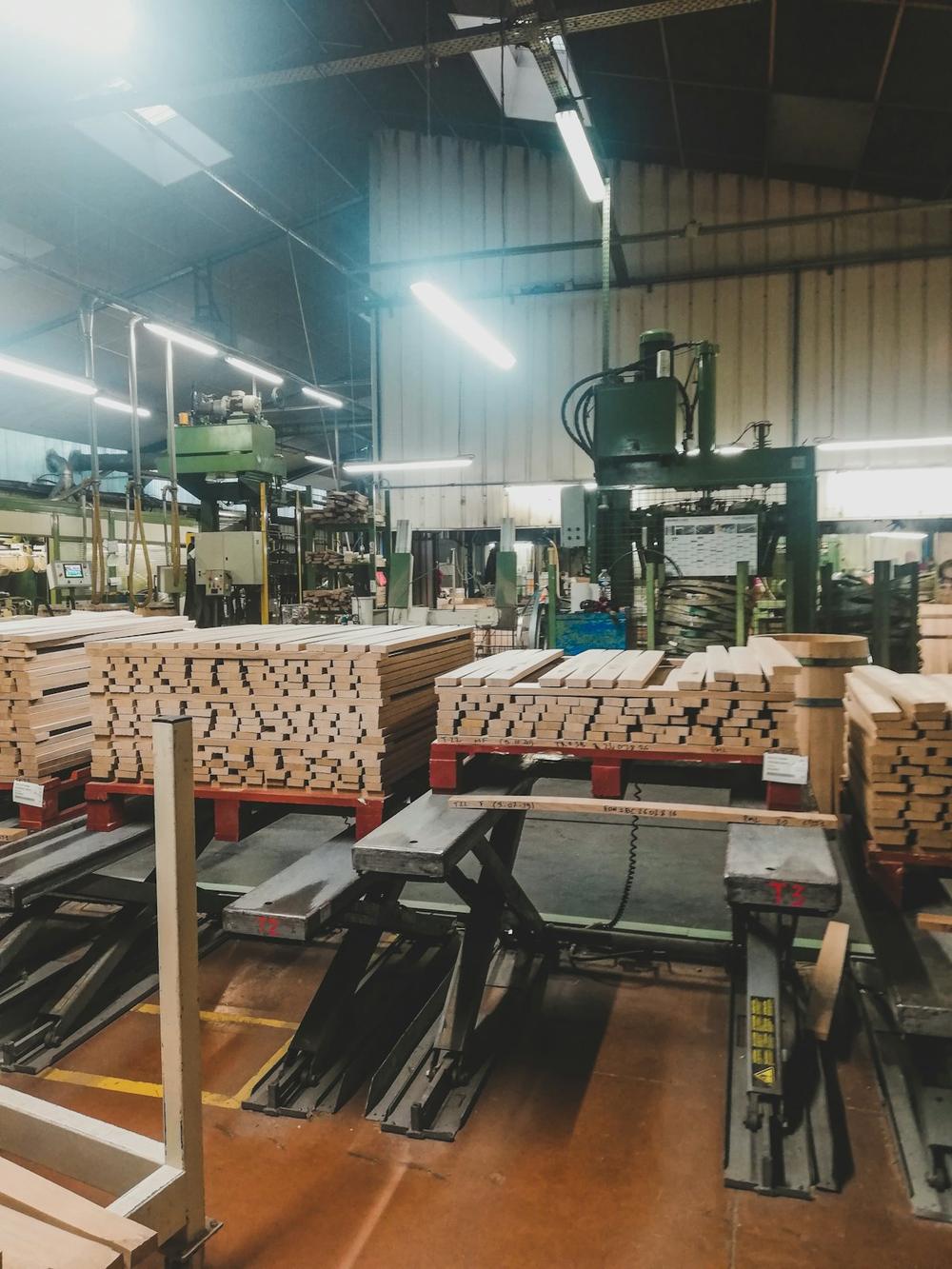
The press line, stage by stage
Settings are typical working ranges for Vietnamese plantation hardwood mills. Each mill sets its own from the glue supplier's data sheet and its veneer. What matters to a buyer is the last column: the defect each stage causes when it is rushed.
| Stage | Machine | Typical setting or output | What goes wrong if rushed |
|---|---|---|---|
| Log yard and bucking | Chainsaw or cut off saw | Plantation logs cut to billets about 1.3 m or 2.6 m long | Billets left in the sun crack at the ends and peel with splits |
| Rotary peeling | Spindleless or spindle lathe | Core veneer commonly about 1.2 to 2.0 mm, face veneer about 0.3 to 1.0 mm | Blunt knives give rough, uneven veneer that telegraphs through the face |
| Clipping and sorting | Clipper, hand sorting | Sheets cut to width, defects removed, sorted core or face | Poor sorting puts face quality veneer in the core and the reverse |
| Veneer drying | Roller or belt dryer, some yard drying | Dryer air typically 120 to 200 °C, veneer to about 6 to 12% by glue type | Wet veneer causes blows in the press. Over dried veneer splits |
| Core composing and patching | Jointing, taping, hand patching | Gaps and overlaps in core layers repaired | Core voids and overlaps show as dents and lumps on the face |
| Glue spreading and layup | Roller glue spreader | Odd number of plies, grain crossed at 90 degrees | Long open time dries the glue surface and weakens the bond |
| Cold pre-press | Cold press | Stack consolidated before hot pressing | Skipped pre-press lets layers shift on loading |
| Hot pressing | Multi opening hot press | Typically 100 to 140 °C and about 1.0 to 1.4 MPa, set by the glue | Fast decompression traps steam and splits the glue line |
| Trimming and calibrating | Edge saws, wide belt sander | Calibrating heads typically 40 to 80 grit, about 0.2 to 0.5 mm per face | Over sanding cuts through thin face veneer |
| Overlay and edge sealing | Second press, edge coater | Phenolic film, melamine paper or veneer face, sealed edges | Dust or moisture on the base shows as bubbles in the film |
Glue and the hot press cycle
The glue sets the press temperature, the cycle time and what the panel survives. Phenolic needs a hotter, longer cycle than urea, which is one reason WBP panels cost more. Time scales with thickness, because heat has to reach the centre of the stack and cure the glue there.
Decompression is the step most often rushed. The steam in the stack has to escape through the edges. Opening the press too fast leaves blows inside the panel that only show when it is sanded or cut.
| Glue | Typical platen temp | Typical pressure | Typical use |
|---|---|---|---|
| Urea formaldehyde (MR) | 100 to 120 °C | 1.0 to 1.2 MPa | Interior panels, packing |
| Melamine fortified urea | 110 to 125 °C | 1.0 to 1.3 MPa | Humid interior, furniture |
| Phenol formaldehyde (WBP) | 125 to 140 °C | 1.1 to 1.4 MPa | Formwork, exterior, flooring |
Typical. The glue supplier's data sheet governs the actual cycle.
Formaldehyde emission classes: E0, E1, E2 and CARB P2
Urea, melamine and phenolic glues all contain formaldehyde. The emission class is a measured result on the finished panel, so it depends on the glue recipe, any scavenger and the press cycle together. Name the class your market requires, not a word like low formaldehyde.
| Class | What it is | Typical limit and test | Market |
|---|---|---|---|
| E2 | European class, above the E1 limit | Above 0.1 ppm (EN 717-1 chamber) | Rarely accepted for interior use in the EU |
| E1 | European class under EN 13986 | Up to 0.1 ppm (EN 717-1 chamber) | Working requirement for the EU market |
| E0 | Trade label, not a European class | Below E1, test and limit vary by scheme | Asked for as margin over E1. Ask which test stands behind it |
| CARB P2 / TSCA Title VI | US law, third party certified | 0.05 ppm for hardwood plywood (ASTM E1333 or E2635) | Required for panels sold in the United States |
| F four star | Japanese JAS class | Average 0.3 mg/L (JIS A 1460 desiccator) | Interior panels for Japan |
A buyer checklist, not legal advice. Limits and methods are revised over time. Background on the US rule is in the Formaldehyde Standards for Composite Wood Products Act. Confirm the current version with your customs broker.
One press or two
Vietnamese mills build panels in one of two routes. Both are legitimate. The right one depends on whether the face will be seen.
One time pressed
All plies glued and stacked, cold pressed, hot pressed once, then trimmed and sanded.
- Lower cost, one press cycle
- Face follows the core, so gaps can telegraph
- Wider thickness spread
- Fits packing, crating and panels that get covered
Two time pressed
Core pressed into a base, repaired and sanded flat, then face and back or film pressed in a second cycle.
- Flatter face, fewer dents and shadows
- Tighter thickness after calibrating the base
- Extra cycle, repair labour and a second sanding
- Fits film faced formwork, furniture faces and shopfitting
Calibrating and the checks that follow
Calibrated sanding brings the panel to one thickness and removes steps from the press. It is why a sanded panel can hold a tighter tolerance than an unsanded one. See plywood materials for face veneer thickness, which limits how much sanding a face can take.
- ThicknessCallipered at several points around the sheet. Sanded and calibrated panels typically hold around plus or minus 0.3 to 0.5 mm.
- MoisturePanel moisture at dispatch, read with a meter, with the oven dry method for disputes.
- BondSoak or boil cycles then a shear test, under EN 314 or the standard your market names.
- EmissionChamber or desiccator test by the method of your class, from a lab the certifier accepts.
- Face and coreFace grade against the agreed table, core gaps and overlaps seen on the cut edge.
Questions about how plywood is made
We are a sourcing service, not a mill. We read your specification and pass it to up to 3 Vietnamese mills that already press that product, and reply within 24 business hours. The mill confirms its own press route, glue and test reports in the quote. For which product suits which job, see plywood applications.
Which glue should I ask for in Vietnam plywood?
Urea formaldehyde (MR) for dry interior use and packing, melamine fortified urea for humid interiors and furniture, and phenolic (WBP) for formwork, exterior and flooring. Name the glue and the emission class in the contract, because a mill that is not told quotes the cheapest bond.
What does E0, E1, E2 or CARB P2 mean for my order?
They are formaldehyde emission classes. E1 is the usual EU requirement, E2 sits above it, and E0 is a trade label for lower emission without one fixed test. The United States requires CARB Phase 2 or TSCA Title VI certification by a recognised third party, so an E0 report alone is not accepted there.
What is two time pressed plywood?
The core is pressed into a base panel first, repaired and sanded flat, and the face and back veneers or a film are pressed on in a second cycle. The face comes out flatter with less telegraphing from core gaps. It costs more because of the extra press cycle and the second sanding.
How is plywood bond quality tested?
By soaking or boiling test pieces and then shearing the glue lines. EN 314 sets the method and the bond classes for Europe, and JAS and other standards have their own cycles. Ask for the test report on your production lot, not a general certificate.
Guides on the press line
- Specification
Hot Press Cycles: How Time, Heat and Pressure Set the Bond
What a plywood hot press does to the glue line, typical temperature, pressure and time by glue type, and the questions that show a mill controls its cycle.
- Specification
One Time or Two Time Pressed: What the Second Press Buys
A second press makes a flatter, smoother panel and costs more. See how one time and two time pressed plywood differ, when each fits and what to put in the spec.
- Specification
Calibrated Sanding: How Plywood Gets Flat and Even in Thickness
Calibrated sanding sets plywood thickness and removes surface steps. See how a wide belt sander works, what it removes, which grits suit which finish.
- Compliance
E0, E1 and CARB P2: Which Class Your Market Needs
How the European emission classes line up against CARB Phase 2 and TSCA Title VI, why an E0 certificate is refused in the US and what to write in the order.
- Specification
Plywood Bond Tests: What Boil, Soak and Shear Actually Prove
Boil, soak and shear tests answer different questions about a plywood glue line. See what each proves, how samples are cut and how to read a test report.
Know the glue, class and finish you need?
Send product, core, glue, emission class, face grade, thickness tolerance and quantity. We pass it to mills that run that line and reply within 24 business hours.