Guides / Specification
One Time or Two Time Pressed: What the Second Press Buys
October 17, 2026
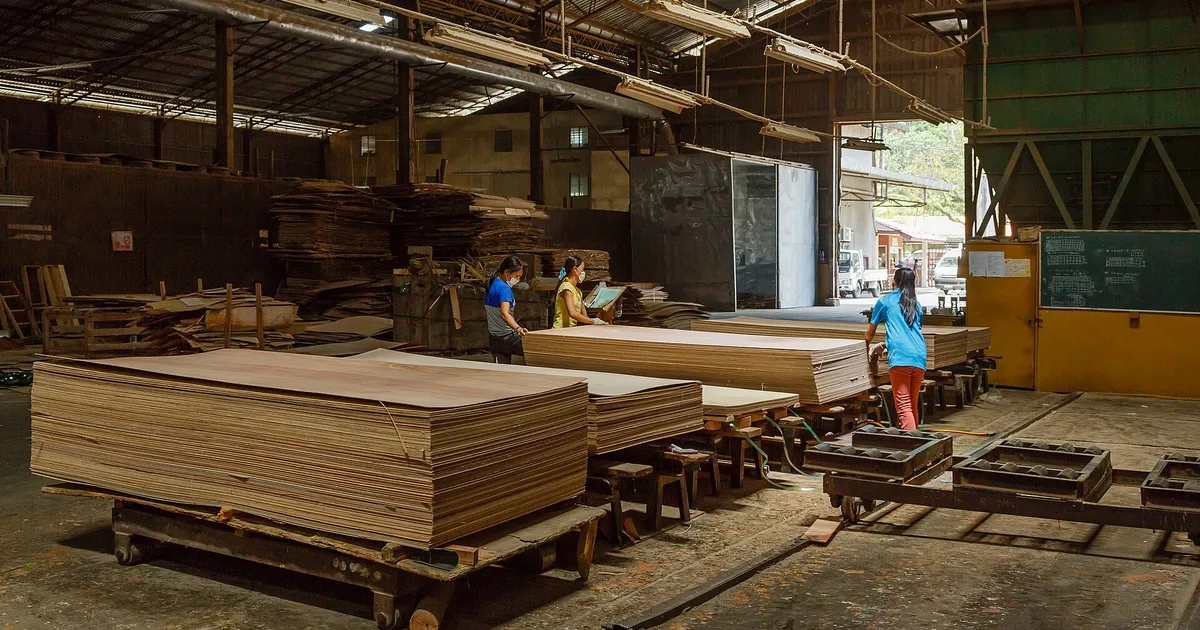
Two panels with the same thickness, the same glue and the same face species can still be priced 5 to 12 per cent apart. A common reason is one word in the quote: the number of times the panel went through the hot press.
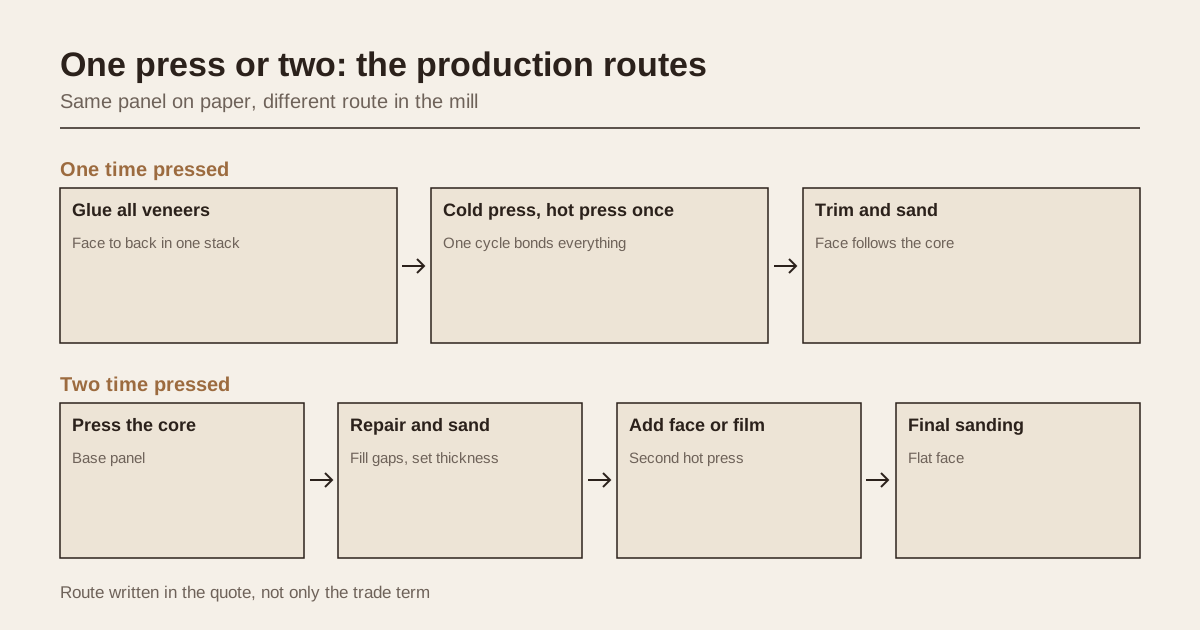
One time pressed and two time pressed are trade terms, not standards. They describe a production route, and the route decides how flat the face is, how well core defects are hidden and how much the panel costs to make.
The two routes
One time pressed. All veneers, from face to back, are glued and stacked into one pile. The pile is cold pressed, then hot pressed once. After the press the panel is trimmed and, if the order says sanded, sanded. Everything is bonded in one step.
Two time pressed. The mill builds in two stages.
- The core veneers are glued and hot pressed into a base panel.
- The base panel is repaired where core gaps or edge voids show, then sanded flat to a uniform thickness.
- The face and back veneers, or a film, are glued onto the sanded base and pressed a second time.
- The finished panel is trimmed and sanded again.
The second route puts the face onto a flat, solid surface. In the first route, the face veneer lies on top of whatever the core happens to be.
Why core gaps show through a face
Rotary-cut core veneers are never perfect. They have small gaps where two pieces meet, overlaps and thin spots. Under pressure the face veneer sinks slightly into each gap, and after sanding the face shows faint dents or shadows, a defect often called telegraphing.
A thin face veneer makes it worse. A 0.3 mm face has almost no ability to bridge a gap, while a 1 mm face hides more. This is why thin decorative faces, films and overlays are the products where a second press pays for itself.
The second route repairs this at the base. Putty or small patches fill the gaps, the sanding machine flattens the surface, and the face goes onto a base that no longer has gaps to sink into. Face veneer species and thickness are discussed in plywood grades explained.
Side by side
| Aspect | One time pressed | Two time pressed |
|---|---|---|
| Hot press passes | One | Two |
| Face flatness | Follows the core | Flat, set by the sanded base |
| Core gap shadows | Can show on thin faces | Mostly hidden |
| Thickness control | Wider spread | Tighter, because the base is calibrated |
| Surface for film or paint | Needs care | Better |
| Cost | Lower | Roughly 5 to 12 per cent higher, typical |
| Lead time | Shorter | Longer by a day or more |
| Typical use | Packing, crates, hidden structure, general | Furniture, film faced formwork, overlays, laser sheets |
The cost step is typical for Vietnam commercial grades. It varies with the mill, the core and the face. The extra cost is mostly an extra press cycle, repair labour and a second sanding.
Where each one fits
One time pressed is the sensible choice when:
- the panel will be hidden, such as backs, crates, pallet tops and sub-structures
- the face will be covered by something thicker, such as a laminate
- price decides the order and the finish does not matter
- thickness spread of a millimetre or so is acceptable
Two time pressed earns its cost when:
- the face carries a clear lacquer or a thin decorative veneer
- the panel gets a phenolic film or a melamine paper, where any dent is visible
- flat, repeatable thickness matters for a router or a laser
- the buyer rejects panels for faint face marks
Film faced formwork is the clearest case. A film shows every core gap, and a gap under the film marks the concrete. For that reason many film faced panels are made by pressing the base first and the film second. The pour count of film faced panels depends on this and on film weight, which is covered in film faced plywood from Vietnam.
A worked cost example
Take an order of 1,000 sheets of 18 mm panel. The one time pressed quote comes in at a base price of 100 units per sheet. A two time pressed quote at an 8 per cent step is 108 units, which is an 8,000 unit difference on the order. If the panels are for cabinet doors with a clear lacquer finish, and one in twenty one time pressed sheets would be rejected for core shadow, then 50 sheets at 100 units are lost. That is a 5,000 unit loss, plus the delay and the claim handling, against a certain 8,000 spent on the second press.
The point of the arithmetic is not that one route always wins. It shows that the decision depends on the reject rate your face will tolerate. If your factory sands the face again or covers it with a thick laminate, the shadow never matters and the extra 8,000 buys nothing. If the face is the product, the second press is usually the cheaper route. Use your own reject rate, not a mill’s average.
Two time pressed and the film
When the second press carries a phenolic film instead of a veneer, the process changes in one more way. The film bonds under heat and pressure with its own resin and needs a smooth, dry, sanded base. If the base has residual dust or moisture, the film can show bubbles or pinholes, which become marks on the concrete later. A mill that presses film in a second cycle usually cleans and checks the base before it goes in.
For formwork it also helps to ask whether the edges of the base were sealed before the film press, since the edge is where water enters later. Edge sealing is the subject of edge sealing plywood before export.
Thickness and weight
The second route changes thickness in two ways. Each hot press compresses the wood slightly, and each sanding removes a thin layer. A mill that builds a nominal 18 mm panel in two presses has to start with a thicker base to land at 18 mm after sanding twice.
Ask whether the thickness in your quote is after both sanding steps. It should be. If the mill quotes 18 mm and delivers 17.2 mm, the sizing and tolerance rules in plywood sizes and tolerance tell you what to claim.
Weight per sheet is slightly higher for a two time pressed panel because of the extra glue line and any filler, which matters when you plan a container.
What a buyer can check
You cannot watch the press, and you can still test the result.
- Lay a straight edge on the face and look for light under it. Dents and ripples show up.
- Hold the panel against a low light at a shallow angle. Telegraphing shows as faint shadows.
- Check thickness at eight points around the sheet with a calliper. A narrow spread points to calibrated sanding.
- Read the cut edge. An extra glue line or a change in veneer thickness between the inner and outer layers suggests a second press.
- Ask for the production route as a line in the quote: “base panel pressed and sanded, face pressed second.”
Questions that separate the routes
When two quotes differ and both say “two time pressed”, a few direct questions show whether they mean the same thing:
- Is the base panel sanded before the face goes on, or only pressed twice?
- How are core gaps repaired, with filler, with patches or not at all?
- What glue is used for the first press and what for the second?
- What is the finished thickness tolerance after the last sanding?
Two mills can both write “two time” and one of them is simply pressing twice. The answers tell you which one is building a flat base and which one is repeating a step.
Writing it into the order
Put the route in plain words and not only in the trade term, because mills use “two time pressed” in slightly different ways. Some use it for any panel with a repaired and sanded base. Others use it only when the face goes on in a separate press.
A clear line reads like this: “Core pressed into a base panel, base repaired and sanded to a uniform thickness, face and back pressed in a second cycle, final sanding after the second press.”
Add a tolerance for face flatness or a visual standard, since “flat” means different things to different people.
Closing checklist
- Decide if the face will be seen, filmed or coated
- Choose one time pressed for hidden or covered panels
- Choose two time pressed for thin faces, films and flat-sheet uses
- Ask for the route and the sanding steps in the quote
- Confirm thickness is measured after the last sanding
- Check a sample with a straight edge and a low light before approving production
Send the specification through the enquiry form with the route written in, and the mills that press this product will quote on the same basis.
Frequently asked questions
What does two time pressed mean?
The panel goes through the hot press twice. The first press bonds the core veneers into a base panel. The base is then patched and sanded, and a second press bonds the face and back veneers or a film onto it. The result has a flatter, cleaner face than a panel made in one press.
Is two time pressed plywood always better?
It is better for flatness and face quality, and it costs more. For packing, crates or hidden structural use, a one time pressed panel is the right product and the second press is money spent on a quality nobody sees.
How can I tell which one I received?
Look at a cut edge. A two time pressed panel often shows a distinct extra glue line between the base and the face layers, and its face is very flat with no core gap shadows. The reliable answer is the mill's production record and the quote wording, so ask for it in writing.
Need a quote for this panel?
Send the specification. We match you with up to 3 Vietnam mills and answer within 24 business hours.
Get matched with a mill