Home / Plywood materials
What Goes Into a Vietnam Plywood Panel
Four materials make the panel: the core veneer, the face, the glue and, on some products, an overlay. Each has its own grade and its own line in the specification.
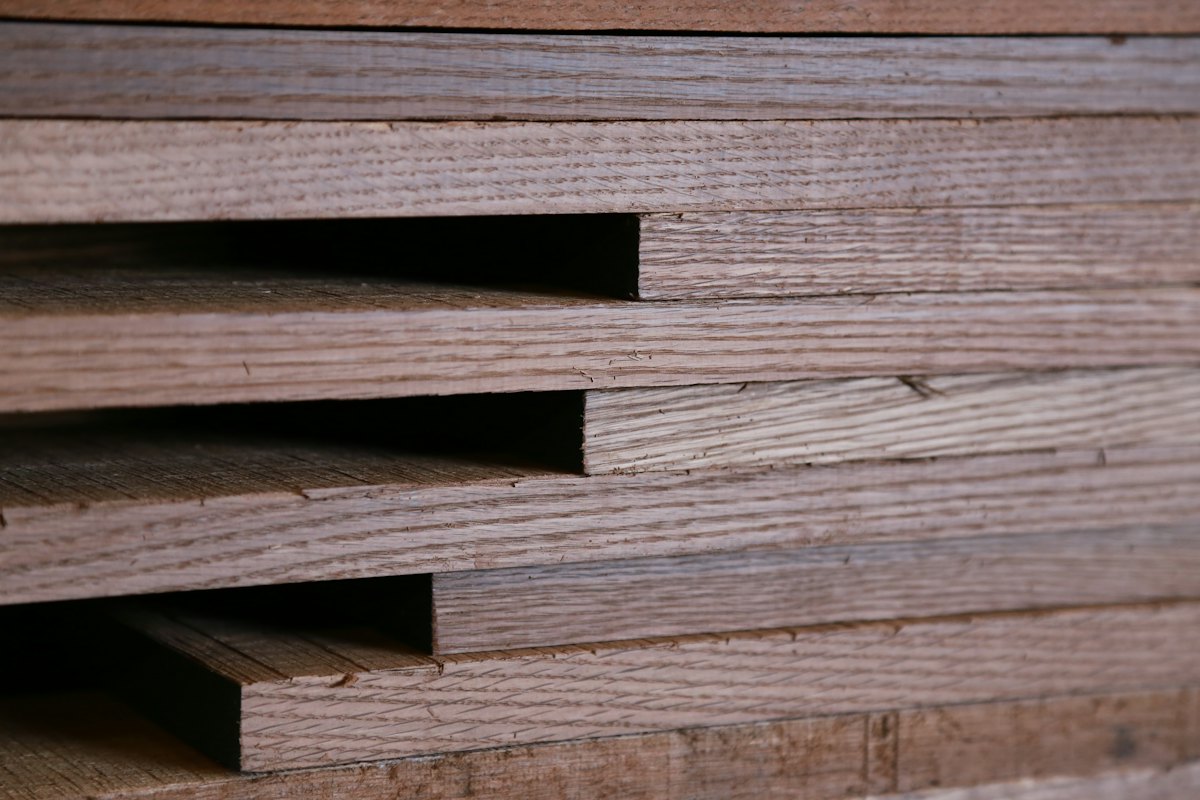
Core species
Vietnamese mills press mostly plantation acacia and eucalyptus, with rubberwood for furniture panels. The core decides weight, stiffness, screw holding and how smooth a base the face sits on. Wood densities are typical air dry values and vary by plantation and age.
| Core | Botanical name | Typical wood density, kg/m3 | What to know |
|---|---|---|---|
| Acacia | Acacia mangium, A. auriculiformis and hybrids | About 550 to 650 | Plantation grown in Vietnam on short rotations. Smooth under a thin face, good screw holding. The default for commercial and furniture panels. |
| Eucalyptus | Eucalyptus urophylla and hybrids | About 600 to 750 | Plantation grown in Vietnam. Harder and stiffer than acacia, common in formwork and flooring cores. Can telegraph through a thin face. |
| Rubberwood | Hevea brasiliensis | About 550 to 650 | Comes from latex plantations at the end of their tapping life. Pale and even, used for furniture panels. |
| Mixed hardwood (combi) | Several plantation species | Varies | Hardwood face plies with cheaper centres. Lower cost and weight, weaker edge screw holding. Fine for dry, light interior work. |
| Poplar | Populus spp. | About 400 to 450 | Light and easy to cut. Not a Vietnamese plantation species, so a poplar core means imported veneer. Ask for veneer origin documents. |
Core build, not just core species
Two panels with the same species and thickness can behave very differently. The build inside is what holds a screw or splits.
- Ply countMore, thinner plies give a flatter, stiffer panel. An 18 mm panel is commonly 11 to 13 plies.
- Full or combi coreFull hardwood throughout, or hardwood outer plies with softer centres. Say which one you accept.
- Voids and overlapsGaps make soft spots and dents under a sanded face. Overlaps make lumps. Agree a limit on the cut edge.
- BalancePlies mirror each other about the center, grain crossed at 90 degrees, so the panel stays flat.
Face veneers and overlays
The face is what you see and what you pay most for per square meter. Thin faces leave little room for sanding, so face thickness and calibrated sanding have to be agreed together. Thicknesses are typical.
| Face | Typical thickness | Typical use | What to know |
|---|---|---|---|
| Natural plantation face | About 0.3 to 0.5 mm | Packing, commercial panels, paint grade | Acacia or eucalyptus face. Color varies across the sheet. |
| Bintangor | About 0.3 to 0.5 mm | Commercial and paint grade panels | Reddish brown imported face, a common commercial plywood face in Asia. |
| Okoume | About 0.3 to 0.6 mm | Light panels, marine type and joinery | Pinkish brown, light and even. Usually imported veneer. |
| Birch | About 0.3 to 1.5 mm | Furniture, shopfitting, CNC parts | Pale, fine and even. Mostly imported veneer, so origin rules apply. |
| Decorative hardwood | About 0.3 to 0.6 mm | Cabinet doors, wall panels, furniture | Red oak, white oak, ash, walnut or maple sliced veneer on a plantation core. |
| Phenolic film | 120, 220 or 440 g/m2 typical | Concrete formwork | Dark brown or black film. Heavier film gives more pours. |
| Melamine paper | Paper weight set by design | Furniture, shopfitting, interiors | Solid color or woodgrain decor, pressed as a finished surface. |
Glue types and emission
The glue sets the bond class and, with the recipe and press cycle, the formaldehyde emission. A mill that is not told quotes MR. The full press settings and the emission classes are on the plywood manufacturing page.
| Glue | Bond | Emission classes reached | Typical use |
|---|---|---|---|
| MR (urea formaldehyde) | Interior, dry use | E2 to E0 or CARB P2 depending on the recipe | Packing, dry furniture carcases |
| Melamine fortified urea (MUF) | Humid interior | E1, E0 or CARB P2 depending on the recipe | Furniture, shopfitting, humid storage |
| WBP (phenol formaldehyde) | Exterior, boil resistant | Low emission by nature of the cured resin, still tested | Formwork, flooring, marine type, exterior joinery |
Bond classes 1, 2 and 3 under EN 314-2 roughly follow dry, humid and exterior use. Ask the mill which standard its bond test follows. Background on plywood construction is a useful primer.
Face grades
Vietnamese mills write grades as a face and back pair, for example B/BB. The letters are a convention, not one standard, so tie the grade to an approved sample.
- ASorted and sanded, uniform color, no open defects. For clear finish and stain.
- BLight color variation, small tight knots, a few neat patches. Stain or paint.
- BBVisible oval patches and sound knots. Paint, laminate or hidden faces.
- CPUtility face, repaired splits, open color variation. Packing and overlays.
- COpen knots and splits within limits. Hidden structure only.
Questions about plywood materials
We are a sourcing service, not a mill. Name core, face, glue and grade in your enquiry and we pass it to up to 3 Vietnamese mills that already press that build, replying within 24 business hours. See plywood applications for the build usually chosen for each end use.
Is acacia or eucalyptus core better for plywood?
Neither is better for every job. Acacia gives a smoother base under thin decorative faces and holds screws well. Eucalyptus is harder and stiffer and suits formwork and flooring cores. Ply count, void tolerance and glue matter as much as the species, so state all of them.
What face grade should I order?
Work back from the finish. Clear finish or stain needs A or B. Paint hides small repairs, so B or BB is enough. Laminate or melamine covers the face, so BB or CP saves money. Hidden structure takes C. Tie the grade to an approved physical sample, because grade letters are a convention rather than one standard.
Why does veneer origin matter for plywood sold to the United States?
Panels pressed in Vietnam from imported core or face veneer have been examined for duty circumvention. Ask the mill for veneer origin documents with the quote and check them with your customs broker. This is a buyer checklist, not legal advice.
Which glue is waterproof?
No plywood glue is described well by the word waterproof. Phenolic (WBP) bonds survive boil tests and suit exterior use. Melamine fortified urea handles humid interiors. Plain urea (MR) is for dry use only. Name the glue in the contract.
Guides on cores, faces and glue
- Specification
Acacia or Eucalyptus Core: What Actually Changes
The two species behind most Vietnam plywood, how they differ in density, screw holding and price, and when a mixed or combi core is the right answer instead.
- Specification
Poplar Core or Hardwood Core: Weight, Strength and Where Each Fits
Poplar core plywood is light and easy to cut, hardwood core is denser and stronger. Compare sheet weight, screw holding and use, and where the core comes from.
- Specification
Rubberwood Plywood from Vietnam: What the Species Brings and Where It Needs Care
Rubberwood is a light plantation hardwood used for plywood faces and cores. See how it compares with acacia and eucalyptus, its weak points and what to specify.
- Specification
Plywood Face Grades: A, B, BB, CP and C
What each plywood face grade allows, how Vietnamese mills write a grade pair like B/BB, and how to pick a grade without paying for a face nobody will see.
- Specification
MR, Melamine or WBP: Which Bond to Ask For
The three glues Vietnam mills press with, what each survives, what it does to the price and how to write the bond into a contract so you get what you paid for.
- Specification
Melamine Faced Plywood: Papers, Colors and What to Check
Melamine faced plywood is a plywood core with a resin-impregnated decor paper pressed on. See paper weights, colour choices, core options and typical defects.
Know the build you want?
Send core, face and back grade, glue, emission class, thickness and quantity. We pass it to mills that press it and reply within 24 business hours.