Guides / Specification
Poplar Core or Hardwood Core: Weight, Strength and Where Each Fits
October 23, 2026

Two sheets of 18 mm plywood can look the same from the face and feel completely different in the hand. One is easy to lift and cut. The other is heavy and hard. The difference is usually the core, and the two most common choices in the trade are poplar and a dense tropical or plantation hardwood.
A buyer chooses a core by use, not by price alone. This article sets the two side by side, with the numbers that move a container plan and a cutting list.
What the core does
The core is the bulk of a panel. In a five-ply sheet the face and back veneers are thin skins, and the three inner layers are the core. The core sets:
- Weight. Wood density is the main driver of sheet weight.
- Stiffness and strength. A denser, stiffer core gives a stiffer panel.
- Screw and nail holding. Denser wood grips fasteners better.
- Surface hardness under the face. A soft core dents under impact, and the dent can show through a thin face.
- Cutting behaviour. Soft, even wood cuts cleanly on a saw, a router and a laser.
The core species is a trade-off along these lines, and the trade-off is simple to state once you see the numbers.
Two species, side by side
| Property | Poplar core | Hardwood core, acacia or eucalyptus |
|---|---|---|
| Typical wood density, kg/m3 | About 400 to 450 | About 550 to 750 |
| Typical finished panel density, kg/m3 | About 480 to 550 | About 600 to 700 |
| Hardness | Low | Medium to high |
| Screw holding | Fair | Good |
| Bending stiffness | Lower | Higher |
| Cutting and routing | Very easy, clean edge | Harder on tools, more heat |
| Laser cutting | Cuts easily | Cuts, slower, more char |
| Typical price position | Often slightly lower | Often slightly higher |
The figures are typical ranges. Panel density also moves with ply count and glue, as explained in plywood weight per sheet.
What it does to sheet weight
For a 1220 x 2440 mm sheet the area is 2.9768 m2, and volume is that area times thickness. Multiply by panel density to get weight.
| Thickness | Volume per sheet | Poplar core at 500 kg/m3 | Hardwood core at 680 kg/m3 |
|---|---|---|---|
| 6 mm | 0.0179 m3 | 8.9 kg | 12.1 kg |
| 9 mm | 0.0268 m3 | 13.4 kg | 18.2 kg |
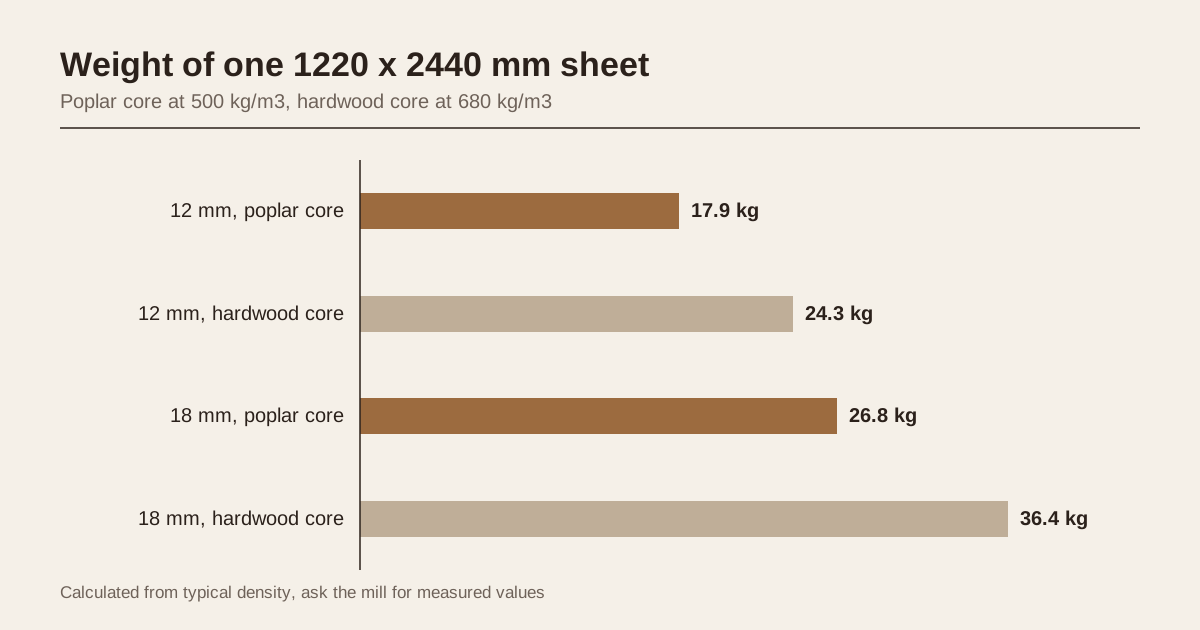
| 12 mm | 0.0357 m3 | 17.9 kg | 24.3 kg |
| 15 mm | 0.0447 m3 | 22.4 kg | 30.4 kg |
| 18 mm | 0.0536 m3 | 26.8 kg | 36.4 kg |
The saving is large. An 18 mm panel with a poplar core is about 10 kg lighter than the hardwood version, which is about 26 per cent. For a worker carrying sheets up a flight of stairs, or a joiner handling a full kitchen run, that matters every day.
It also shows in freight. A container loaded with lighter panels hits its volume limit before its weight limit, and a container of dense panels does the opposite. Planning is covered in how many plywood sheets fit in a container.
Where poplar fits
Poplar core suits uses where light weight and clean cutting count more than strength.
- Furniture carcasses and cabinets where panels are supported at several points
- Drawer boxes, backs and shelves with modest loads
- Boxes, crates and display fixtures
- CNC and laser work where soft, even wood gives a clean cut
- Craft, model and signage panels
- Wall and ceiling panels where weight is limited
A thin decorative face over a poplar core is a popular combination for flat-pack furniture, because it keeps weight down and cuts well.
Where a hardwood core fits better
Dense cores belong where the panel works hard.
- Concrete formwork with repeated handling and nailing
- Flooring and sub-flooring under concentrated loads
- Truck and trailer floors and platforms, discussed in plywood for truck and trailer floors
- Structural and bracing panels
- Shelves with long spans and heavy loads
- Panels where screws must hold in the edge
For the two common Vietnam species, see acacia or eucalyptus core. Species matters less than density and core quality, and a dense, tight, gap-free core usually outperforms a loosely made one of a stronger species.
A worked example, one kitchen order
A cabinet maker orders 120 sheets of 18 mm panel for a block of flat-pack kitchens. With a poplar core at 500 kg/m3, each sheet weighs about 26.8 kg and the order weighs 3.2 tonnes. With a hardwood core at 680 kg/m3, each sheet weighs about 36.4 kg and the order weighs 4.4 tonnes. The difference of 1.2 tonnes shows up in handling, in the weight of each flat-pack box and in the cost of delivery per cabinet.
On the other side of the ledger, the hardwood core panel holds hinge and drawer-runner screws better, and takes more abuse during assembly. A maker who ships flat-pack boxes to end customers may prefer the lighter box and use hardware that suits a softer core. A maker who builds heavy built-in units may prefer the dense panel. The numbers do not choose for you, and they show what you give up either way.
Fasteners and hardware
Soft cores have a trade-off with screws. Most hinge screws and cam fittings used in cabinets are designed for particleboard and MDF and work well in poplar plywood. They bite less in a soft core than in a dense one, so the pull-out force is lower.
Three habits help when a poplar core meets hardware.
- Pre-drill pilot holes of the right diameter, since over-tight holes split thin layers and over-large holes strip.
- Use fittings made for panel work, such as confirmat screws and knock-down cam connectors, in place of wood screws driven into the edge.
- Reinforce high-load points, with a hardwood strip or a metal insert behind hinges on heavy doors.
Ask a hardware supplier for pull-out values on the specific panel, or test a sample on site. The numbers are easy to measure and remove guesswork.
Moisture and warp
A lighter core is also more reactive to humidity changes in some cases, because low-density wood takes up and loses water quickly. A poplar panel that ships at a moisture content above the range for the destination can warp or cup sooner than a dense one. The same rules of moisture control apply, and they are described in veneer drying and plywood moisture content.
Balanced construction matters just as much. A panel with a thick, dense face on one side and a thin, soft one on the other will bow with humidity change. Ask the mill to confirm that face and back are balanced in species and thickness.
Edge quality and voids
Rotary-cut poplar veneer is soft and often thin, and piecing it into a core leaves joints. A core of poplar with gaps shows up as dents in the face of a thin decorative panel and as voids in the cut edge. For furniture where the edge is shown, ask for a gap-free core, or for edge banding, and check a cut sample.
For laser or CNC work, voids burn or catch the tool. Sheets sold for those uses should be sold with a clear core standard, as in plywood sheets for laser cutting and craft.
Where the poplar comes from
Poplar is a temperate tree. The big commercial poplar plantations are in northern China, Europe and North America. Vietnam’s plantation timber is dominated by acacia and eucalyptus, with rubberwood as a third source. A quote for poplar core from a Vietnam mill therefore raises a question about the supply chain.
Three answers are possible. The mill may press with imported poplar veneer, the mill may buy poplar core panels or sheets and press the face itself, or the mill may be sourcing poplar from outside Vietnam in some other way. Each answer has a different cost, a different lead time and a different set of documents.
Ask the mill:
- Where does the core veneer come from, and in what form does it arrive?
- Who processes it, and is the pressing done at the mill?
- What documents describe the species and origin?
- How does it appear on the invoice and the certificate of origin?
Origin is a practical and a legal matter. Wood-based products are covered by import rules that ask for species and origin, as described in EUDR requirements for plywood and Lacey Act plywood declarations. If the poplar is imported, the documents need to show the real source, and a buyer who does not ask will find out at customs.
Mixed cores
Some panels use a mixed core, for example a poplar centre with hardwood inner layers, or a hardwood face with a poplar core. These are sold as combi or mixed-core panels, and they sit between the two extremes in weight and strength. A mixed core is a legitimate product, and a quote should say which layers are which. A mill that says “hardwood core” for a mixed panel is saying something that cannot be checked.
Testing the difference
You can see the difference with three simple checks on samples.
- Weigh a sheet and compare it with the figure in the quote.
- Drive a screw into the edge a set depth from the face and try to pull it out. Hardwood resists more.
- Press a thumbnail into the cut edge. Poplar marks easily, and hardwood resists.
A laboratory can also measure density and bending properties. A quick density check on a sample panel often settles the question before the order is placed.
Writing it into the order
- Core species named, with the layers if the core is mixed
- Panel density range, or sheet weight range, at stated moisture
- Core quality: no gaps, or gaps limited by size and number
- Glue type and emission class
- Documents showing origin of the core veneer
Closing checklist
- Decide by use: light and easy to cut or dense and strong
- Compare sheet weights for your thickness before you compare prices
- Confirm where the poplar comes from if poplar is offered
- Ask for a density figure measured on a recent batch
- Test a sample for screw holding and edge hardness
- Put species, layers and documents into the order
Tell us the use and the thickness in the enquiry form, and up to three Vietnam mills will say which core they can press for it.
Frequently asked questions
Is poplar core plywood weaker than hardwood core?
Yes, for most mechanical properties. Poplar is a light, soft wood, so a poplar core panel has lower density, lower hardness and lower screw holding than a panel with an acacia or eucalyptus core. For cabinets, shelving, crates and craft work it is strong enough. For flooring, formwork and heavy loads a hardwood core is the safer choice.
Is poplar grown in Vietnam?
Poplar is a temperate tree grown mainly in northern China, Europe and North America. Vietnam's plywood cores are mostly acacia and eucalyptus. A quote for poplar core from a Vietnam mill usually means imported veneer, so ask where the core veneer comes from and how it is documented.
How much lighter is a poplar core panel?
A typical poplar core panel is around 25 to 30 per cent lighter than a hardwood core panel of the same thickness. An 18 mm sheet of 1220 x 2440 mm weighs roughly 26 kg with a poplar core and about 36 kg with a dense hardwood core. Use measured density from the mill for container planning.
Need a quote for this panel?
Send the specification. We match you with up to 3 Vietnam mills and answer within 24 business hours.
Get matched with a mill