Guides / Specification
Plywood for Speaker Boxes: Stiffness, Damping and Panel Specification
October 25, 2026
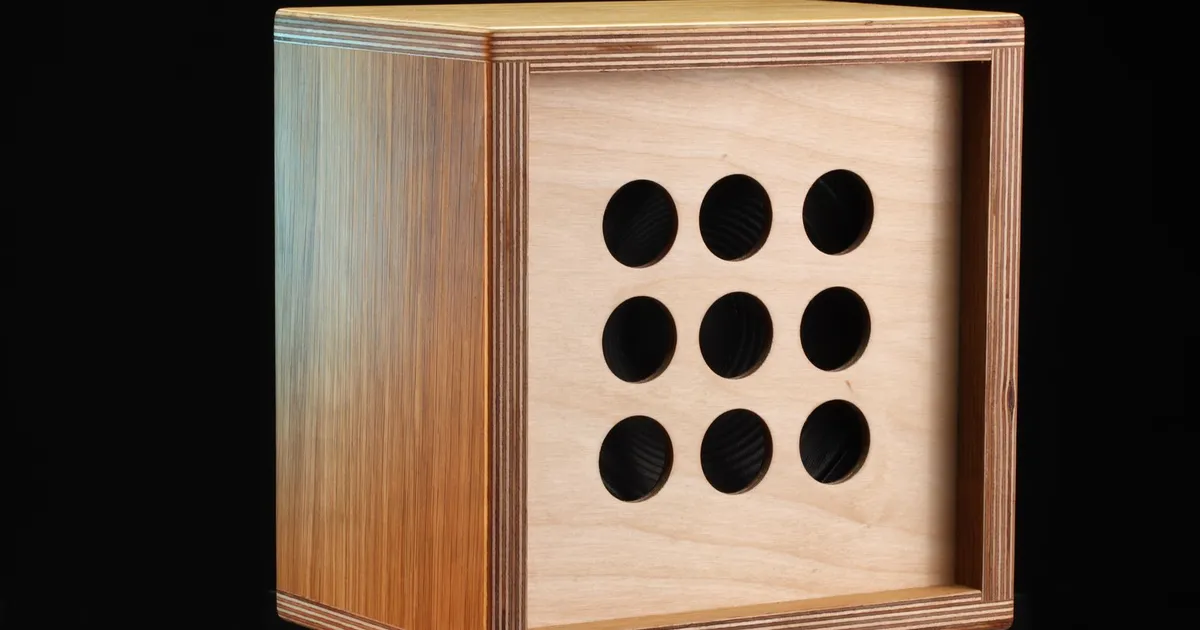
A speaker cabinet has one job beyond holding the drivers. It must keep quiet. Every panel is a surface that can vibrate, and any vibration that adds sound to the driver’s output colours the result. Cabinet builders choose materials and structure to keep the walls from singing.
Plywood is one of the favourite materials for the job. It is stiff, it screws and glues well and it machines to precise cut-outs. It also comes with traps, and the traps are in the panel specification.
What the cabinet wall has to do
A speaker wall faces four demands.
- Stay rigid. A stiff wall pushes its own resonance up and out of the range where the speaker works hardest.
- Lose energy. A wall that damps vibration quickly stops ringing when the music stops.
- Hold fixings. Screws for drivers, terminals and bracing need a solid grip.
- Machine cleanly. Driver cut-outs, rebates and ports need accurate, burr-free edges.
Different materials trade these against each other, and no single material wins all four.
Materials compared
The figures below are typical ranges and give a feel for the trade-offs. They are not a design basis, and your designer should measure the panels actually used.
| Material | Typical density, kg/m3 | Stiffness for its weight | Internal damping | Screw holding | Machining |
|---|---|---|---|---|---|
| Hardwood plywood, void-free | About 650 to 750 | High | Moderate | Good | Good |
| Birch plywood, fine multi-ply | About 650 to 700 | High | Moderate | Good | Very good |
| Poplar plywood | About 450 to 550 | Medium | Moderate | Fair | Very good |
| MDF | About 700 to 800 | Medium | High | Fair at the edge | Very good, dusty |
| Particleboard | About 650 to 750 | Lower | Medium | Fair | Fair |
Plywood tends to win on stiffness for weight and on screw holding. MDF tends to win on damping and uniformity, with no grain direction and no voids. Many builders choose plywood for the stiffness and add damping inside the box with bracing, felt or bitumen sheet.
Why thickness and span matter
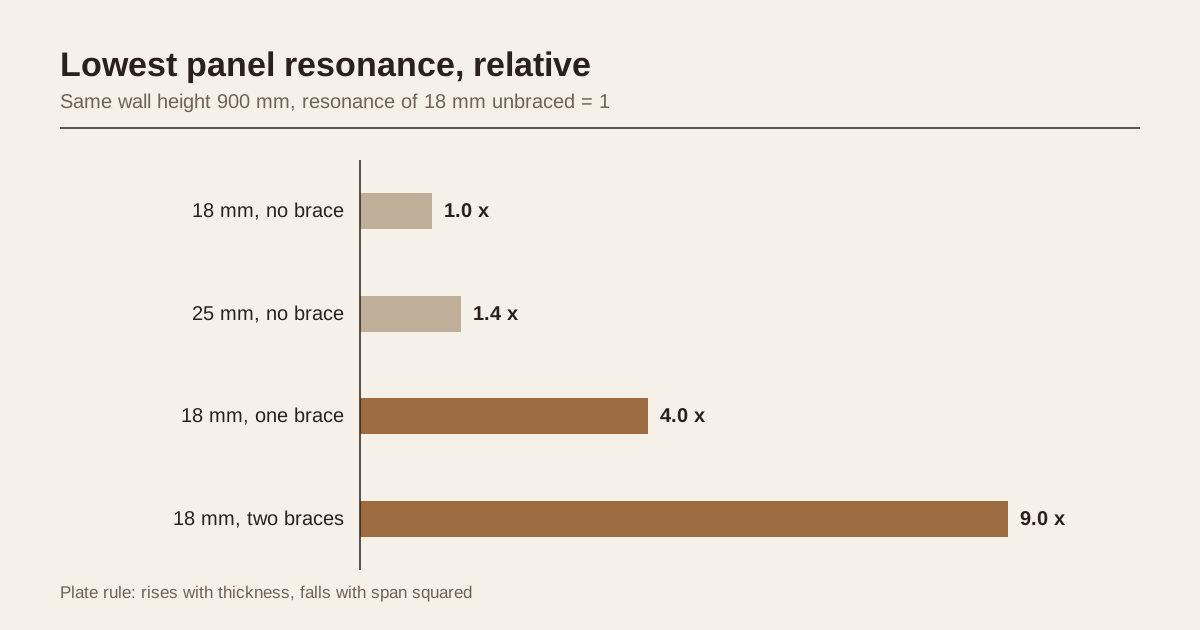
The lowest panel resonance depends on the thickness, the unsupported span and the material. For a flat plate, resonance frequency rises in proportion to thickness and falls with the square of the span. In plain terms, doubling the thickness raises the frequency about two times, and halving the span raises it about four times.
That relationship has two practical effects.
- Thicker walls help, but with diminishing returns after a point, and the weight rises with them.
- Bracing helps more. A brace across the middle of a panel halves its span and raises the resonance about four times, which is more than doubling the thickness would do.
A 18 mm panel with two braces can outperform a 25 mm panel with none. Builders choose thickness and bracing together.
Thickness and weight
For cabinet walls, 15, 18 and 25 mm are common. Heavy designs use two layers bonded together, with damping between them. Weight is real, and sheet weights help plan:
| Thickness | Weight per 1220 x 2440 sheet at 680 kg/m3 |
|---|---|
| 12 mm | 24.3 kg |
| 15 mm | 30.4 kg |
| 18 mm | 36.4 kg |
| 25 mm | 50.6 kg |
The numbers come from the same calculation as in plywood weight per sheet. A pair of floor-standing speakers with 25 mm walls can reach tens of kilograms each.
A worked example, one bracing decision
A floor-standing cabinet has side walls 900 mm tall and 300 mm wide, made from 18 mm panel. The long unsupported span of each side is 900 mm. A single shelf brace at mid-height cuts that span to 450 mm. The lowest panel resonance rises by about four times, assuming the same material and thickness, because frequency scales with the inverse of span squared. A second brace at one third of the height cuts the span to 300 mm and raises the frequency by about nine times compared with the unbraced wall.
By comparison, going from 18 mm to 25 mm raises the frequency by about 1.4 times. Bracing is much cheaper per unit of gain than thickness. A builder who has a fixed weight budget gets more from two braces and a modest wall than from a thick wall with a hollow interior. That is why many well-regarded cabinets use medium thickness plywood with generous bracing.
Damping inside the box
Stiffness moves a resonance. Damping removes the energy at it. Builders add damping in three ways.
- Felt or foam lining on some walls, which absorbs sound inside the cabinet and reduces the standing waves
- Bitumen or viscoelastic sheet bonded to the panel, which converts vibration into heat
- Constrained layer construction, two panels bonded with a damping layer between them
Plywood has moderate internal damping, higher than metal and lower than MDF in many tests, so the combination of a stiff panel and added damping gives a quiet wall. Glue choice matters here too: a thick, stiff glue line in a laminated panel carries vibration, and a more compliant line damps it. The details belong to the speaker designer.
Joints that stay tight
A joint carries vibration from one panel to the next. A loose joint also rattles. Four habits keep joints tight.
- Rebates or mitres that give a large glue area, instead of simple butt joints.
- Glue along the whole joint, with enough clamp pressure to close it.
- Dowels or biscuits to align panels and add stiffness.
- Screws in the right places, such as driver rings and terminal plates, and not as the main joint.
A sealed cabinet must also be airtight. Glue the joints along their length and seal cable entries and the terminal plate with gasket or sealant. An air leak makes a sealed box sound like a vented one.
Showing the plies
Many modern cabinets show the plywood edge as a design feature. Fine multi-ply panels, with many thin, even layers, look good as an edge, and builders sand and clear-coat the edges to show the layers. This turns a core quality problem into a visible one.
- Void-free edges are required, since any gap shows.
- Even ply thickness gives a clean stripe pattern.
- Matching species between face and inner plies gives a more uniform look.
- Edge finishing, sanding up to a fine grit and oil or lacquer, protects the wood and shows the layers.
This is a different product from a panel for a painted cabinet, and it costs more. Tell the mill which one you need. The same decision applies to cabinet furniture, as in furniture grade plywood for cabinets.
Voids, gaps and rattles
For a speaker, the core of the panel matters as much as the face.
- Voids can buzz when a bass note drives the panel at the right frequency.
- Gaps near fixings weaken screw holding where the driver bolts on.
- Gaps in cut-outs leave rough edges that chip and can leak air.
- Soft spots give uneven stiffness across a wall.
Builders ask for void-free plywood, usually with many thin plies and no open gaps. Fine multi-ply panels cost more than standard panels, because the mill sorts and repairs the core. Panel structure and grades are explained in plywood grades explained, and a clean cutting core is also the subject of furniture grade plywood for cabinets.
Glue and moisture
Speaker cabinets sit indoors, and an interior glue is enough for most. Phenolic glue gives a margin for cabinets used in humid rooms, outdoors or in vehicles. Panel moisture matters because a panel that moves can open joints and let air leak, and a leak spoils a sealed cabinet. Ask for a moisture range suited to the workshop and the destination, as in veneer drying and plywood moisture content.
Acclimatise sheets in the workshop for several days before cutting, and glue joints with a good wood glue and clamps. A glued joint is stiffer than a screwed one, and a rigid joint carries less vibration to the next panel.
Machining and finish
Plywood is easy to cut on a CNC router when the sheet is flat and the core is clean.
- Flatness keeps cut-outs the same depth from sheet to sheet.
- Consistent thickness keeps rebates and joints tight, and calibrated sanding gives this, as covered in calibrated sanding and plywood flatness.
- Sharp tools and the right feed avoid tear-out on the face veneer.
- Edge finishing matters when the layers show as a design feature.
Finishes range from veneer and lacquer to paint, vinyl wrap and textured coatings. A good paint finish needs a smooth, sanded face. Open-grained faces need grain filling.
Formaldehyde and enclosed spaces
A speaker box is a small enclosed space, and some builders care about emission from the panels. Choose a low-emission class suited to the destination market and ask for the report, as set out in E0, E1 and CARB P2 compared.
Writing it into the order
- Thickness and tolerance, with measurement points
- Ply count and a void-free core, or a gap limit
- Species and density range
- Sanded faces and final grit for the planned finish
- Flatness limit and moisture range
- Glue type and emission class, with the report
- Sheet size and edge protection in packing
Closing checklist
- Pick thickness and bracing together
- Ask for a void-free core near cut-outs and joints
- Check flatness and thickness spread on a sample
- Cut and test a sample on your own router
- Choose glue by use, indoor, humid or outdoor
- Keep sheets flat and acclimatise before cutting
Send the thickness and the quantity through the enquiry form, and up to three Vietnam mills that press fine multi-ply panels will quote.
Frequently asked questions
Is plywood good for speaker cabinets?
Yes. Plywood has a high stiffness for its weight, holds screws well and machines cleanly, and many builders use it for cabinets. It rings more than MDF in some designs, so builders add bracing and internal damping. The right choice depends on the design and the finish.
What thickness of plywood suits a speaker box?
Common cabinet walls are 15, 18 or 25 mm, and heavy designs use two bonded layers. Thicker walls and shorter unsupported spans raise the lowest panel resonance. Take the figure from the design and the driver size, not from a general rule.
Why do voids matter in speaker plywood?
A void inside a panel can rattle, buzz or leave a gap at a screw or a cut-out. Builders ask for a void-free core, or at least a core with no gaps near driver cut-outs, ports and joints. A gap-free core also gives cleaner CNC routing.
Need a quote for this panel?
Send the specification. We match you with up to 3 Vietnam mills and answer within 24 business hours.
Get matched with a mill