Guides / Specification
Rubberwood Plywood from Vietnam: What the Species Brings and Where It Needs Care
October 24, 2026
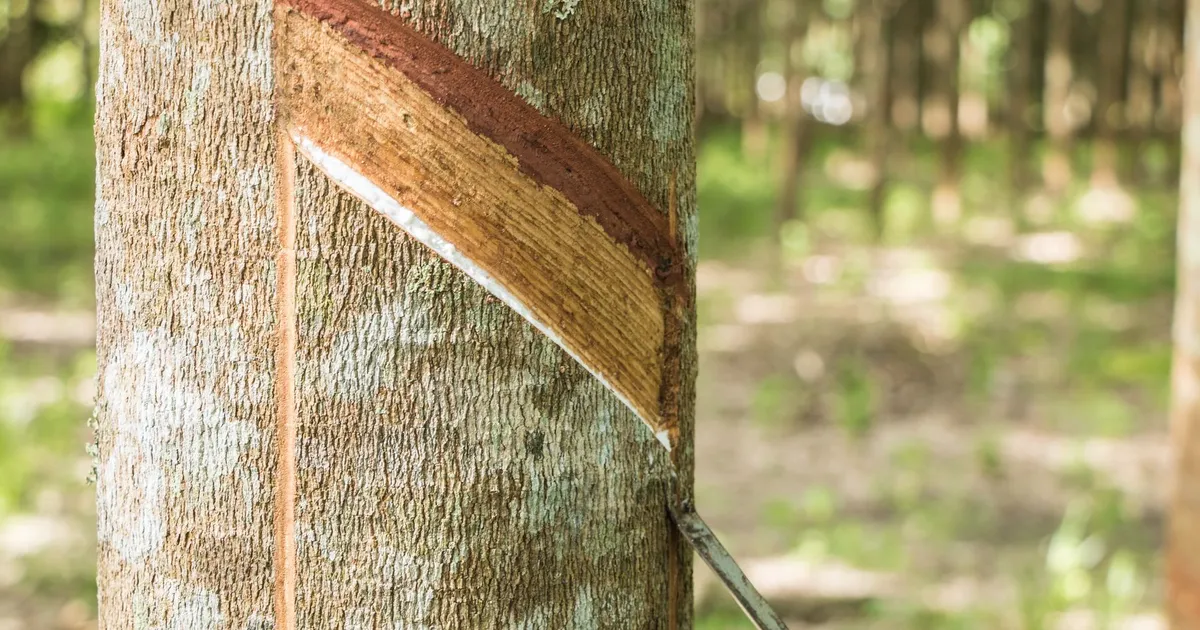
Walk through a plantation in the south of Vietnam and you are looking at the source of two products. The first is latex, tapped from the trunk every few days. The second is timber, harvested once the tree is past its best latex years. That second product is rubberwood, and a share of it ends up as veneer.
For plywood buyers the species is worth understanding because it behaves differently from the acacia and eucalyptus that dominate Vietnam’s panel cores. It has real advantages and a few weaknesses that a quote will not mention.
Where the wood comes from
Rubber trees are planted in dense rows and tapped for decades. When latex yield falls, the plantation is cleared and replanted. The old trunks used to be burned or left to rot. Today they supply sawn timber for furniture and a smaller share goes into veneer and plywood.
Three things follow from this origin:
- Supply depends on replanting cycles. Timber arrives when plantations are cleared, and large blocks come in waves.
- Trunks are modest in diameter, which suits peeling into thin veneer and not large logs.
- Quality varies with the plantation. Tapping scars, latex stains and growth stresses differ between logs.
This is a plantation wood. The rules that apply to origin evidence for plantation timber, and any rules specific to rubberwood, are covered in EUDR requirements for plywood. Do not assume the answer. Ask for origin records before you order.
What the wood is like
Rubberwood is a light-coloured hardwood, creamy to pale straw, with little contrast between sapwood and heartwood. The grain is fairly straight and the texture is fine and even.
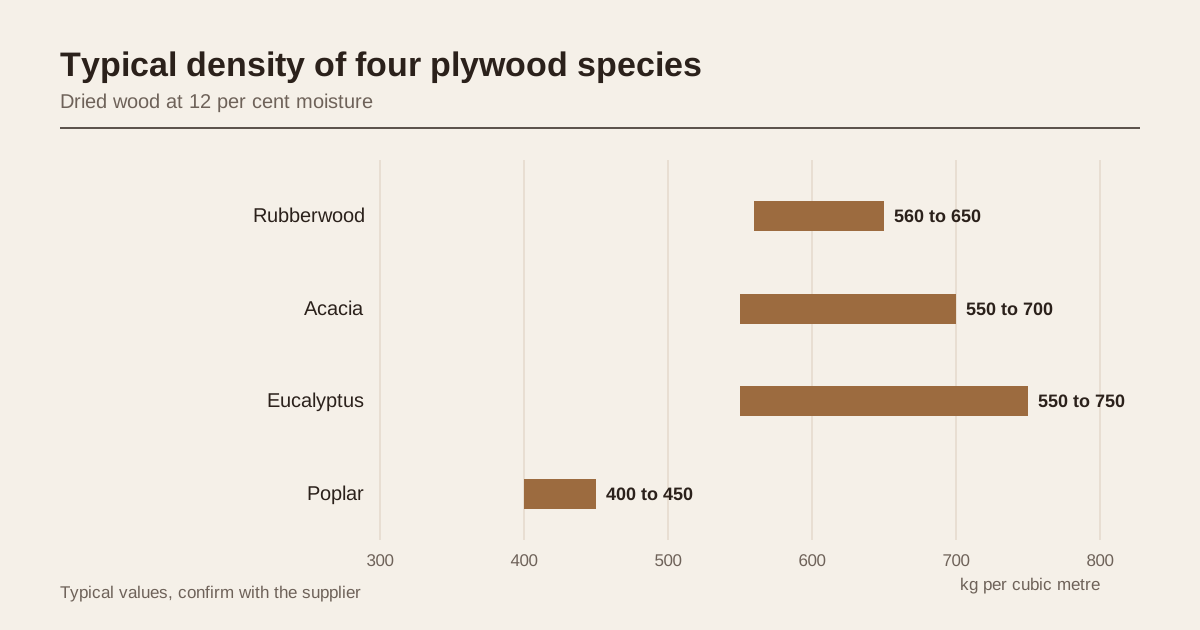
| Property | Rubberwood | Acacia | Eucalyptus | Poplar |
|---|---|---|---|---|
| Colour | Pale cream to straw | Light to medium brown | Pale pink to brown | Very pale |
| Typical density at 12 per cent moisture, kg/m3 | About 560 to 650 | About 550 to 700 | About 550 to 750 | About 400 to 450 |
| Texture | Fine, even | Medium | Medium to coarse | Fine, soft |
| Screw holding | Good | Good | Good | Fair |
| Natural durability | Poor, needs treatment | Fair | Fair | Poor |
The figures are typical ranges for dried wood and vary with the tree and the plantation. For the two common Vietnam core species see acacia or eucalyptus core.
Why buyers like it
- Colour. A pale, uniform face takes stain, paint and clear lacquer evenly, and it suits light-toned furniture.
- Texture. The fine, even surface sands to a smooth finish with little tear-out.
- Machining. It cuts and routes cleanly with sharp tools and moderate wear.
- Weight. It sits in the middle of the density range, not as light as poplar and lighter than a dense eucalyptus.
For cabinet and furniture panels that will be seen, these properties are real advantages, and they are the reason rubberwood face veneers are used on decorative panels in several producing countries.
Where it needs care
Rubberwood has a poor reputation in some corners of the timber trade for good reason. Three issues recur.
Staining. Freshly cut rubberwood contains starch and sugar, which feed fungi. A log left for a few days can develop blue and grey stain throughout. The stain is a cosmetic fault and it can make a pale face look blotchy. Mills prevent it by processing logs quickly and treating them.
Insect attack. The same starch and sugar attract powder-post beetles and other borers. Untreated rubberwood can show small exit holes later. A preservative treatment, often a boron compound applied soon after felling or before peeling, controls this.
Dimensional movement. Rubberwood can move with humidity, and growth stresses cause some distortion in sawn timber. Plywood construction with crossed veneers controls most of this, and a poorly dried core can still cause warp.
Ask a mill three plain questions: how soon after felling are logs processed, what treatment is applied and how is the treatment documented? The answers show whether the wood is handled as a managed material or as a by-product.
Rubberwood in the panel
A mill can use rubberwood in three ways.
- As a face veneer on a core of another species, giving a pale decorative surface.
- As a core veneer in a panel with a different face.
- As both face and core, for an all-rubberwood panel.
The honest way to spec it is to say where it is. A quote that says “rubberwood plywood” without saying which layers are rubberwood leaves room for a mixed panel, with a rubberwood face and a cheaper core. Panel structure and grades are explained in plywood grades explained.
Veneer yield and the core gap problem
Rubber trees are modest in size, and the trunks that come out of a plantation are shorter and thinner than hardwood logs from natural forest. A small log peels into narrower sheets, and the sheets contain more tapping scars and small defects. Mills clip around the defects and join the good pieces into full-size sheets, a process called composing or piecing.
For the buyer this has one practical effect: core quality. A core made of many narrow pieces has more joints, and each joint is a place where a gap can open or an overlap can form. Core gaps hurt flatness, screw holding at the edge and the finish under a thin face. If your panel has a thin decorative face, a rubberwood core with many joints can telegraph through it, which is another argument for the flat-base route described in one time vs two time pressed plywood.
When to choose it and when not to
| Need | Rubberwood | Acacia or eucalyptus |
|---|---|---|
| Pale, uniform face for light furniture | Good fit | Face may be darker or more varied |
| Cabinet carcass and shelves | Good fit | Good fit |
| Formwork and heavy reuse | Weak choice, softer and less durable | Usual choice |
| Flooring and load-bearing panels | Not typical | Usual choice |
| Outdoor or wet service | Weak, even with phenolic glue | Better, with the right glue |
| Painted or stained interiors | Good fit | Good fit |
The pattern is simple. Rubberwood suits interior, visible, furniture-type work. It is not the first choice for hard use.
What counts as a stain defect
Blue and grey stain is the most common reason a rubberwood panel is rejected on appearance. The grade you ask for decides how much is acceptable. Three levels are common in the trade:
- No stain allowed on the face. The strictest grade, and the hardest to meet, because the stain can be present only on the back.
- Light stain allowed, no dark patches. A middle grade for painted or stained panels.
- Stain allowed on the back and inner layers. A grade for panels where only one face is seen.
Write the stain limit into the order, with a photo of an acceptable and an unacceptable face. “Rubberwood A grade” means different things at different mills.
Checking that it is rubberwood
A mixed-species panel is the commonest substitution. A quote for “rubberwood plywood” can arrive as a panel with a rubberwood face over a mixed hardwood core, or with a face of another pale species. A buyer can confirm the species in three ways:
- Visual check of the face, which only suggests the species and does not prove it
- Wood identification by a laboratory, using a microscope on a small sample, which is a routine test and is not costly
- Documents from the supplier showing the wood species and the plantation source
For a first order, a lab identification on one sample is good value, especially if the species is part of the product claim. Treat species as something to confirm, not to assume.
Price position and supply cycles
Rubberwood pricing follows the supply cycle. When a large block of plantation is cleared, logs are plentiful and prices soften. When the rubber price is high, owners delay clearing and timber is scarce. This means a quote can change more with the season than a quote for acacia, which is grown on a fixed rotation. The detailed drivers of price are in what drives the price of Vietnam plywood.
Ask the mill how long its current rubberwood stock will last. A mill that is pressing from a planned stock can hold a price for an order. A mill buying logs by the truck cannot.
Treatment and what it means for you
Preservative treatment protects the wood and also raises questions.
- Which chemical, and is it accepted in your destination market? Boron-based treatments are widely used for rubberwood. Other products have restrictions in some countries.
- Where the treatment happens, at the log, at the veneer or on the panel.
- Documentation. A treatment record or a supplier’s statement is part of the file.
Some markets ask about treated wood on import, and plywood for food contact or toys has its own rules. Check with your customs broker if the end use is sensitive.
Glue and formaldehyde
Rubberwood does not change which glues a mill uses. The same rules apply: phenolic for wet or exterior service, urea or melamine fortified urea for interior service. Formaldehyde emission depends on the glue, the press and the control process, as explained in formaldehyde tests for plywood. Ask for the class you need, whatever the species.
A specification line
Write the structure and the species into the order in plain words:
- Face veneer species and thickness, for example rubberwood face 0.5 mm
- Core species and ply count
- Glue type and emission class
- Treatment against staining and insects, with the product named
- Origin evidence required for the logs, and the format
- Thickness, size, finish and moisture range
Closing checklist
- Decide where in the panel rubberwood is wanted: face, core or both
- Ask how fast logs are processed after felling
- Ask for the preservative product and the treatment record
- Request origin records for the plantation source
- Check the glue and emission class as for any other species
- Look at a sample panel for stain and insect holes before approving production
Send the species and structure you want through the enquiry form, and up to three Vietnam mills that already press it will respond.
Frequently asked questions
What is rubberwood?
Rubberwood is the timber of the Para rubber tree, Hevea brasiliensis, grown mainly for latex. When the tree stops giving enough latex, usually after around 25 to 30 years, it is cut down and the trunk is sawn or peeled. It is a light-coloured hardwood with a fine, even texture.
Is rubberwood plywood good for furniture?
Yes, for interior furniture and cabinet panels. The pale, even colour takes stain and paint well. It needs proper drying and preservative treatment, because the wood is prone to staining and insect attack if it is left untreated after felling.
Does rubberwood plywood qualify under the EU deforestation rule?
Treatment of rubberwood under the EU Deforestation Regulation depends on how the product and the plantation are classified and documented. Do not assume either way. Ask the mill for plot-level origin records and confirm the position with your customs broker before ordering.
Need a quote for this panel?
Send the specification. We match you with up to 3 Vietnam mills and answer within 24 business hours.
Get matched with a mill