Guides / Compliance
Formaldehyde Tests for Plywood: Chamber vs Desiccator
October 21, 2026
Formaldehyde reports from plywood mills look similar and often are not comparable. One gives milligrams per cubic metre, another gives parts per million and a third gives milligrams per litre. All three can say the panel passes, and all three can be correct, because each uses its own test.
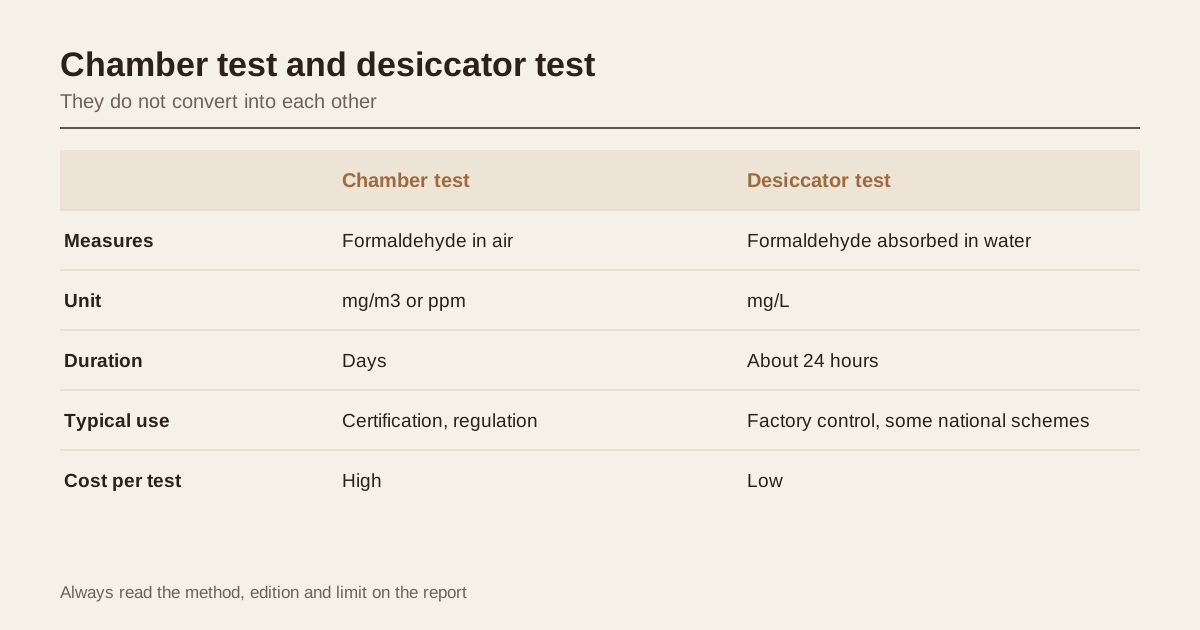
If you buy plywood for several markets, the choice between a chamber test and a desiccator test decides which of your orders have valid paperwork.
Why formaldehyde is tested
Urea formaldehyde and phenol formaldehyde glues release small amounts of formaldehyde gas as they cure and for some time afterwards. Phenolic bonded panels usually release much less than urea bonded panels, and the glue formula, the cure and any scavenger added to the glue move the number further.
Regulators and buyers set limits because indoor air quality matters. The limits are different in the EU, the US, Japan and China, which is why this article is about tests and the next steps are about classes. The classes and how they line up are explained in E0, E1 and CARB P2 compared.
The chamber test
A chamber test puts panels in a sealed room, controls temperature and humidity, and measures how much formaldehyde builds up in the air.
- Setup. The panel sample is loaded into a chamber at a fixed ratio of panel surface area to chamber volume, called the loading ratio. Air is exchanged at a set rate, with temperature and humidity held constant.
- Measurement. Air from the chamber is sampled until the concentration reaches a steady state, which can take days.
- Result. Concentration of formaldehyde in the air, in milligrams per cubic metre or parts per million.
Chambers are expensive and slow, which is why there are different sizes.
| Method | Chamber size | Result | Where it applies |
|---|---|---|---|
| EN 717-1 | About 1 m3 | mg/m3 of air | European classes |
| ASTM E1333 | Large, about 22 m3 | ppm of air | US hardwood plywood rules |
| ASTM D6007 | Small, a fraction of a cubic metre | ppm of air | Correlated quality control |
The large chamber is the reference for US compliance. The small chamber is cheaper and faster and is used for routine control when it has been correlated to the large one.
The desiccator test
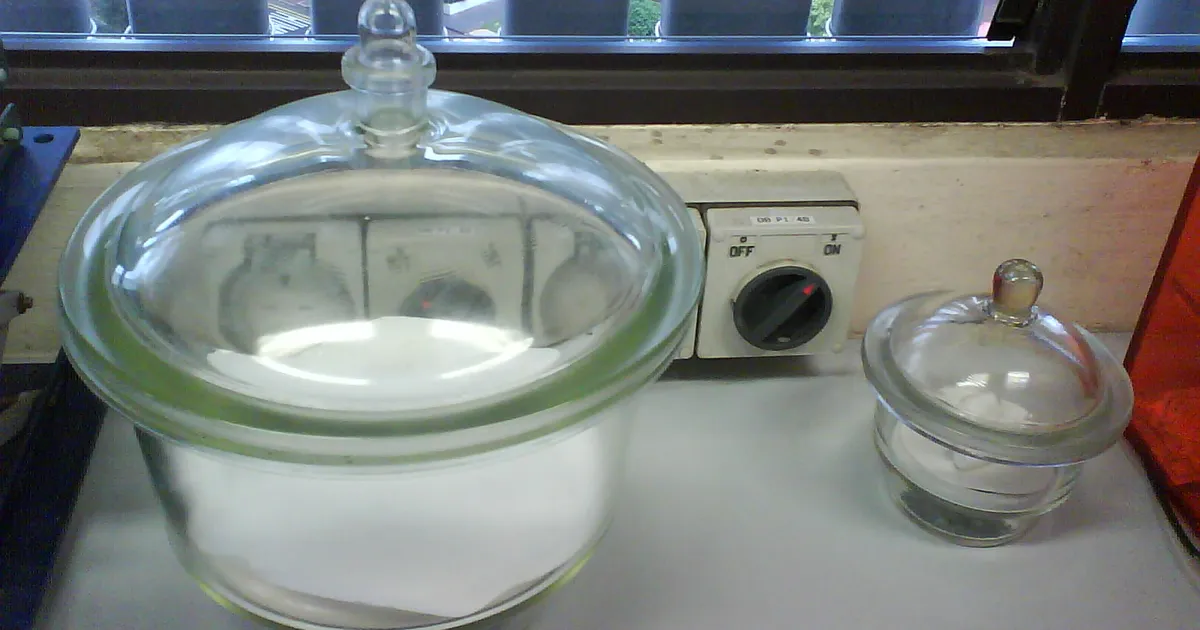
A desiccator test uses a small sealed glass vessel with a dish of water inside. A panel sample sits above the water, and formaldehyde released by the sample dissolves in the water over about 24 hours. The water is then analysed with a colour reaction, and the result is the concentration in the water.
- Setup. A set number of small test pieces of fixed surface area, a fixed volume of water and a fixed temperature.
- Measurement. After the exposure period, the water is analysed.
- Result. Milligrams of formaldehyde per litre of water.
Desiccator tests are simple, cheap and quick, and many mills in Asia use them for daily control. Japanese standards and Chinese standards both define limits using this type of method. The Japanese star classes, for example, are set in milligrams per litre.
Side by side
| Aspect | Chamber test | Desiccator test |
|---|---|---|
| What is measured | Formaldehyde in air | Formaldehyde absorbed in water |
| Unit | mg/m3 or ppm | mg/L |
| Sample size | Whole panels or large pieces | Small cut pieces |
| Duration | Days | About 24 hours |
| Cost per test | High | Low |
| Typical use | Certification, regulation | Factory control, some national schemes |
| Variation | Lower, closer to real use | Higher, depends on sample cutting |
The key point is that the two tests do not convert into each other. A panel with a given chamber value does not have a predictable desiccator value, and the reverse is also true. Mills sometimes publish a rough comparison table. Treat it as an indication, not as proof for any market.
How to read a report
A test report that can be relied on has the same elements regardless of method.
- Method and edition. The name of the standard and its year. Limits and test details change.
- Product. Description, thickness, glue type, face species and production date.
- Sampling. Who cut the sample, from which panels and when. A sample sent by the mill itself carries less weight than a sample drawn by a third party.
- Result. The number, the unit and the limit it was compared against.
- Laboratory. Name and address, and whether the laboratory’s competence is recognised by an accreditation body for this test. Check the scope of the accreditation, because it is specific to test methods.
- Date. An old report on a different batch is not a report on your goods.
A one-page summary with no method, no date and no laboratory is a claim and not evidence.
Matching the test to the market
Pick the test from the destination, not from the mill’s habit.
- European Union and countries following its standards. Chamber results to the European method, often asked as E1. The glue family and the emission limit are described in the standard and in the national rules on formaldehyde for wood-based panels.
- United States. Formaldehyde emission limits apply to hardwood plywood under federal and California rules. They are tied to large-chamber testing, or a correlated quality control method, and to third-party certification with panel labels. The practical steps are in CARB P2 and TSCA Title VI for Vietnam plywood.
- Japan. The desiccator method defines the star classes, and the highest class is the usual ask.
- Korea, China and other Asian markets. Each uses its own scheme, often with a desiccator or similar small method. Check the current rule with your broker.
If you ship into more than one market, ask the mill which of its tests are third-party and which are factory control, and plan to carry the correct report for each destination.
What a mill does between certified tests
A third-party test happens a few times a year at most. The panel in your container was pressed on a different day, with a different batch of glue. What connects the two is the mill’s own control.
A mill that controls emission checks it every day or every shift with a quick method, most often a small desiccator test, and records the numbers. It also controls the factors that move the result:
- Glue mix. The ratio of formaldehyde to urea in the resin, and any scavenger added to the mix, set the baseline.
- Glue spread. More glue means more potential release, so spread is weighed and logged.
- Press cycle. A cure that runs short leaves unreacted resin in the glue line.
- Conditioning. Fresh panels are stacked with gaps for a period so emissions fall before packing.
When a daily test number drifts upward, the mill sees it before a customer does and changes the mix. A mill with no daily record has no way to know. The question “what do you check every day” gets a more useful answer than “do you have a report”.
Why a passing report can still disappoint
Three situations account for most disappointments.
- The report covers a different product. A phenolic bonded panel passes with a wide margin, and the order is for a urea bonded panel from the same mill. The report belongs to the other product.
- The report is old. Glue suppliers change formulations, and resin batches vary. A report from last year says what the mill could do then.
- The sample was chosen by the mill. A sample sent by the mill may be the best sheet of the day. A sample drawn from a pallet by an independent inspector represents the shipment better.
None of these means the mill acted in bad faith. They mean a report is a snapshot, and a buyer who understands this asks for fresh, batch-linked evidence on the first order and spot checks on later ones.
A note on units
The units alone confuse many buyers. A value of 0.05 ppm in air and a value of 0.5 mg/L in water look like they are in the same family. They are not. Parts per million in air describes concentration in a chamber after the test reaches a steady state. Milligrams per litre describes the amount captured in a dish of water. The first is closer to what a person would breathe in a room, and the second is a comparison tool that works inside its own scheme.
If someone gives you a “conversion table” between the two, ask who produced it, which products it was built on and what correlation was measured. A table with no source is a guess.
Sampling and timing
Emission falls with time after pressing, and a panel tested a week after the press can show a higher number than the same panel a month later. Standards deal with this by specifying conditioning before testing. Even so, the date of manufacture matters, and a report on freshly pressed panels is more conservative than a report on stored stock.
Sampling position matters too. Edges can emit more than the middle, and the standard sets how test pieces are cut. A buyer who asks for third-party sampling at the mill, as part of pre-shipment inspection, controls this part.
Questions for the mill
- Which method do you test with in the factory, and which method for certification?
- Is the certification test run by a third party, and which laboratory?
- What is your result on this product and thickness, with the report date?
- How do you control emission in production, glue formula, press cycle and conditioning?
- Will you test again on a sample drawn by my inspector before loading?
Closing checklist
- Destination market known, and the correct method and limit identified
- Method, edition, laboratory and date on every report
- Test linked to the product, thickness and production batch
- Certification kept separate from factory control tests
- Third-party sampling arranged for the first shipment
- No emission claim written into the order without naming the standard
Send the destination and the class you need through the enquiry form, and up to three Vietnam mills will say which test and report they can supply.
Which test the US and EU rules name is summarised in our guide to plywood import requirements.
See also: plywood formaldehyde test methods compared for how the chamber, desiccator and gas analysis numbers differ by market.
Frequently asked questions
Which is stricter, a chamber test or a desiccator test?
Neither is stricter in a simple sense, because they measure different things in different units and carry different limits. A chamber test measures concentration in air in a controlled room. A desiccator test measures what a small sample releases into water in a sealed vessel. A low number on one does not convert to a number on the other.
Can I use a desiccator report for the US market?
Not directly. The US rules for hardwood plywood are written around large chamber testing, or a quality control method that has been correlated to it, and they require a recognised third party certifier. A desiccator report may support quality control and does not replace that certification.
What should a test report show?
The method and its edition, the product description and thickness, the sampling date, the production batch, the result in the units of the method and the laboratory name. A report with only the word pass, or one without a date, should be treated as unconfirmed.
Need a quote for this panel?
Send the specification. We match you with up to 3 Vietnam mills and answer within 24 business hours.
Get matched with a mill