Guides / Compliance
Fire Retardant Plywood: Grades, Test Methods and Honest Claims
October 12, 2026
Plywood burns. Every wood panel does. A fire retardant treatment does not change that. What it changes is how fast the flame spreads, how much heat the panel gives off and how much smoke it makes during the first minutes of a fire, which are the minutes that matter for escape.
Because the benefit is measured and not visible, the word retardant on a quote proves nothing. A classification from a recognised test does.
Two systems that do not translate
Two systems dominate the trade. They use different tests, different classes and different paperwork.
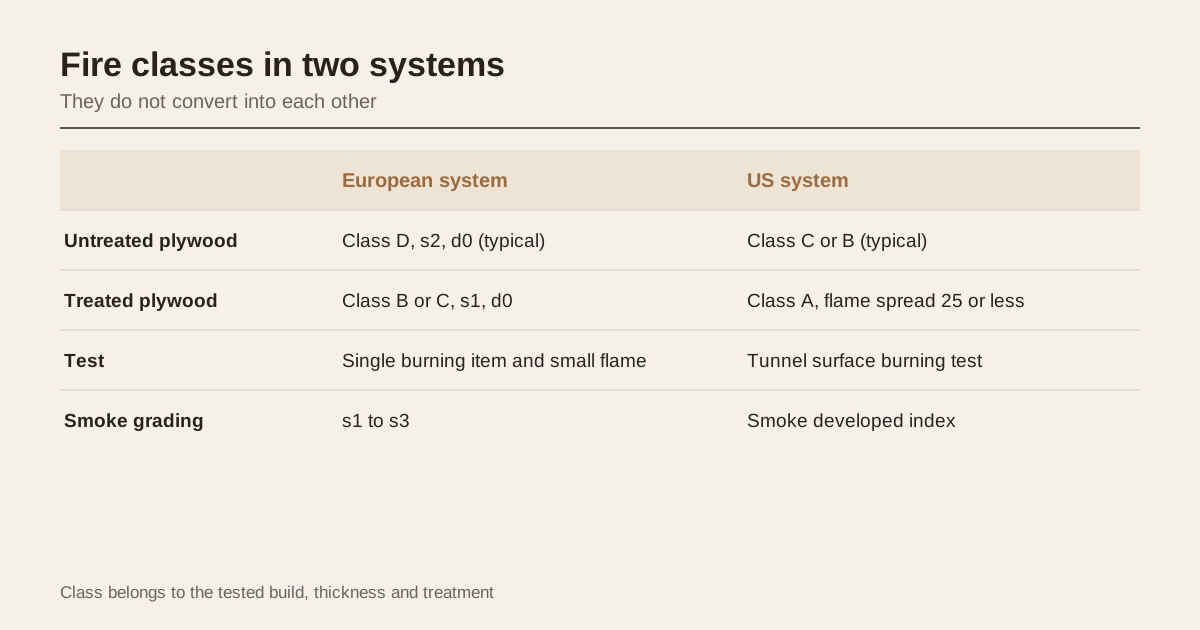
| Feature | European system | US system |
|---|---|---|
| Standard for classification | Reaction to fire classification of construction products | Surface burning test |
| Typical test | Single burning item test and small flame tests | Steiner tunnel test |
| Classes | A1, A2, B, C, D, E, F plus smoke s1 to s3 and droplets d0 to d2 | Class A, B and C by flame spread index, plus smoke developed index |
| Typical result for untreated plywood | Class D, with smoke and droplets s2, d0 | Class C or B depending on species and thickness |
| Typical treated result | Class B or C, depending on treatment | Class A, with flame spread of 25 or less |
| Where it is asked | Construction products in the EU | Building codes in the US |
The classes are not equivalent, and a result in one system does not convert into the other. Choose the system that your market and your project use.
What the European letters mean
The system rates a product A1 to F.
- A1 and A2 are non-combustible or almost so, and no wood panel reaches them.
- B is very limited contribution to fire, the top class that treated wood panels can reach.
- C is limited contribution to fire.
- D is acceptable contribution to fire, where untreated wood panels of normal thickness sit.
- E is acceptable reaction to a small flame only.
- F is no performance determined.
The letter is followed by two codes. Smoke production runs from s1, low, to s3, high. Burning droplets run from d0, none, to d2, many. A classification written B-s1,d0 means very limited contribution, low smoke and no burning droplets.
What the US numbers mean
The US surface burning test runs a panel on the ceiling of a long tunnel, with a gas flame at one end, and measures how far the flame travels and how much smoke is produced. Results are two numbers:
- Flame spread index. Class A is 0 to 25, class B is 26 to 75 and class C is 76 to 200.
- Smoke developed index. A limit of 450 or less is usually required for the top classes.
A panel is described as class A, or class 1, when its flame spread is 25 or less and its smoke developed is within the limit. Treated panels sold as FRT plywood often carry this class, with the rating printed on the panel.
How a panel becomes fire retardant
Four routes are used, and each has trade-offs.
- Pressure impregnation. The panel is soaked with a chemical solution under pressure, dried and sometimes redried to a set moisture. The chemical goes deep into the wood. It is the most common route for panels sold as FRT in the US.
- Treated veneer. The veneers are treated before pressing. The retardant sits in the veneer and the glue bonds to treated wood, which can be difficult.
- Glue line additives. The retardant is added to the glue and spread between layers. The effect on flame spread is real and more limited than impregnation.
- Surface coatings. Intumescent paint or varnish forms a protective foam when heated. It protects the face and depends on the coating staying intact.
The method matters because it decides what a test result covers. A report for an impregnated panel does not apply to a panel with only a coating, even if the two look the same.
What treatment does to the panel
Fire retardant chemicals are mostly salts, and they change the panel in other ways.
- Moisture. Many retardant salts attract water from the air. A treated panel in a humid place can pick up moisture and develop surface bloom or weeping.
- Strength. Some treatments reduce bending strength and nail holding by a few per cent to more than ten per cent, depending on the chemical and the process.
- Fasteners. Salt-treated wood can corrode some metal fasteners, and the supplier will name suitable ones.
- Gluing and finishing. Treated surfaces can bond and take paint differently.
- Exposure. An interior type is for dry service. An exterior type has a leach-resistant treatment for rain and wetting. They are not interchangeable.
Ask for the type, the retention in kilograms per cubic metre, and the strength adjustments.
Where fire retardant panels are asked for
Specifiers ask for treated panels where building rules limit surface flame spread, or where a fire would have severe results.
- Public buildings, such as schools, hospitals, cinemas and exhibition halls, where interior linings are controlled
- Escape routes, corridors and stairs, where the wall and ceiling finish must slow the spread of flame
- Stage sets and temporary structures that use large areas of wood panel in front of the public
- Transport interiors, such as rail, coach and ship fit-outs, which have their own standards
- Roof and wall sheathing in regions where wildfire exposure drives the code
The type of building and the local code decide the class, and a buyer who does not know the class should ask the architect or the fire engineer before placing an order.
Price and lead time
Treated panels cost more than untreated panels of the same build. The extra comes from the chemical, the treatment process and the testing behind the claim. For impregnated panels, add drying time after treatment, which lengthens the lead time. Tested products also carry a share of the laboratory cost.
A quote that sits well below others for the same class has probably skipped something: a lower retention, a coating in place of impregnation, or a test report for a different build. Compare the retention, the method and the report together with the price, as set out in what drives the price of Vietnam plywood.
What a buyer can check on arrival
None of the following replaces a test report, and each helps catch a mismatch between the report and the panel.
- Marks. The panel carries the classification, the treatment name and a lot code that matches the documents.
- Weight. A treated panel is usually heavier than an untreated one of the same thickness, because it holds the chemical. A sheet at the same weight as untreated stock is suspicious.
- Surface. White or crystalline bloom on the surface, or damp spots, point to salt migration in humid storage.
- Cut edge. An impregnated panel often shows a uniform colour change through the cut, and a surface coating shows only on the face.
- Moisture. Treated panels are redried after treatment. A high moisture reading suggests a skipped drying step.
Keep photos of marks and a record of weights and moisture readings with the lot number. They make a claim possible if the panel later fails a site check, as described in plywood defects on arrival.
Reading a test report
A fire test report carries the validity of the claim. Six checks keep it honest.
- Standard and edition. The classification standard and the test standard, with years.
- Product tested. Panel type, thickness, species, glue, treatment and retention.
- Test laboratory. Name and address, and whether it is recognised by an accreditation body for this test.
- Result and class. The class or the indices, with smoke and droplet grades.
- Field of application. Which thicknesses, densities and mounting methods the result covers.
- Validity. The date and the period over which the report stays valid.
A report for a 12 mm panel does not prove a 25 mm panel. A report on a different treatment does not prove yours. The test belongs to the exact build, and the description on the report must match your product.
Marking and traceability
Fire retardant panels are usually marked with the classification, the treatment and a lot code, so that an inspector can link a panel on site to a test. Ask for the marking in the order, and keep photos of marks on delivered panels with lot numbers.
In some markets, treated wood is inspected under a third-party program with listing and labelling. Do not assume that a Vietnam mill participates. Ask whether the product is listed, by whom and under which scope, and check the answer with the listing body.
Claims to avoid
- Fireproof. No wood panel is fireproof.
- Non-combustible. Not true for any wood panel.
- Fire rated for a number of minutes. A fire resistance rating belongs to an assembly, a wall or a door, tested as a whole. It does not belong to a panel.
- Class A without a test. The class belongs to a test result.
A mill that uses these words has given you a reason to look harder at the rest of the quote.
Writing it into the order
- Classification system and class wanted, for example B-s1,d0 or Class A flame spread
- Treatment method and retention
- Interior or exterior type
- Test reports linked to the panel build, thickness, glue and treatment
- Marking of panels and lot codes
- Strength and fastener recommendations from the treater
See also plywood bond tests: boil, soak and shear for the glue line and commercial vs structural plywood for how declared properties and marks work.
Closing checklist
- Pick the classification system by destination
- Ask for the full test report, not only the certificate summary
- Check that the build in the report matches the order
- Ask about moisture, strength and fastener effects of the treatment
- Avoid the words fireproof and non-combustible in the specification
- Verify marks and listings with the issuing body
Send the class and the end use through the enquiry form, and up to three Vietnam mills will say whether they can supply panels with a matching test report.
Frequently asked questions
Is fire retardant plywood fireproof?
No. A fire retardant treatment slows flame spread and reduces heat and smoke release for a limited time. The panel will still char and burn under sustained fire. Any quote that says fireproof plywood is using the wrong word and should be questioned.
What do the European fire classes mean?
The European system rates a product from A1 to F for reaction to fire, then adds a smoke grade, s1 to s3, and a burning droplet grade, d0 to d2. Untreated plywood of normal thickness typically falls in class D. Treated plywood can reach class B or C, depending on the treatment and the test.
Can a Vietnam mill supply tested fire retardant plywood?
Some mills treat panels or buy treated veneer, and what they can claim depends on the tests behind the product. A report is valid for the tested build, thickness, glue and treatment. Ask for the test report and the classification document, and check that they match the panel you are buying.
Need a quote for this panel?
Send the specification. We match you with up to 3 Vietnam mills and answer within 24 business hours.
Get matched with a mill