Guides / Specification
Plywood Bond Tests: What Boil, Soak and Shear Actually Prove
October 18, 2026
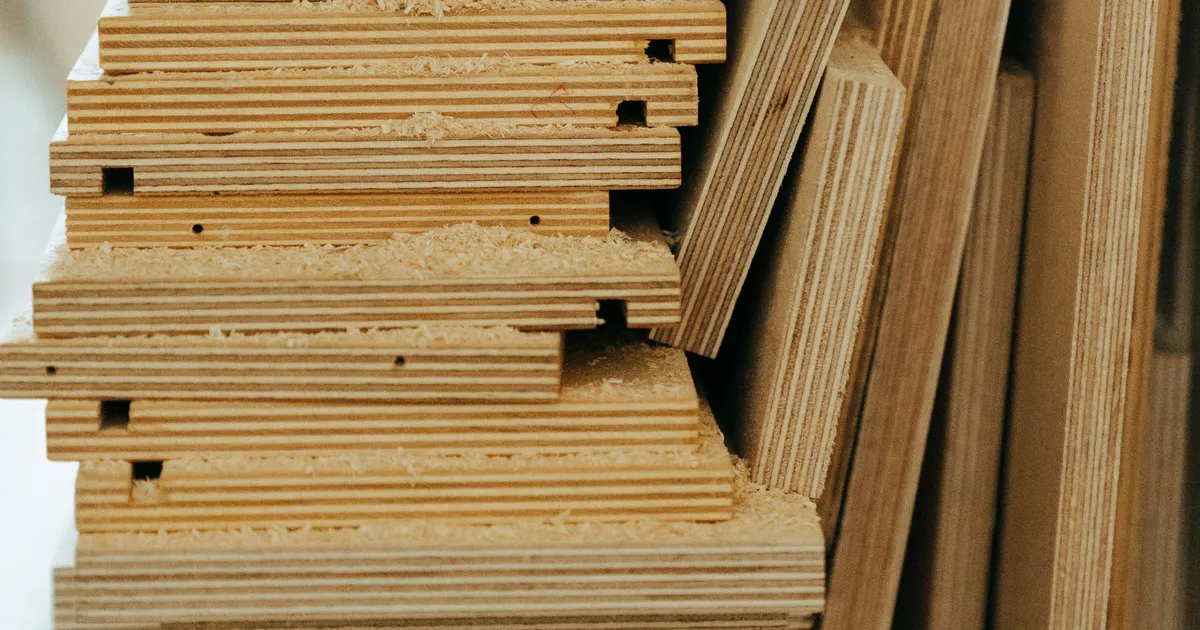
A plywood panel can look identical to another and hold together far worse. The glue line is the part you cannot see, and a bond test is the only way to find out what it will do when it gets wet or loaded.
Three words appear in almost every bond test report: boil, soak and shear. They are often written as if they mean the same thing. They do not, and a report that gives one without the others answers a narrower question than it seems to.
Two jobs in one test
A bond test does two jobs in sequence.
- Pretreatment. The sample is stressed with water, heat or both. This is where soak and boil come in. The aim is to imitate what the panel will face in service, in a hurry.
- Mechanical test. The sample is pulled apart in a testing machine, usually in shear, and the force at failure is recorded together with the amount of wood failure.
A soak or a boil on its own, with no pulling, is only a visual check for delamination. A shear test on a dry sample, with no pretreatment, tells you the glue is strong when nothing is attacking it. The useful result comes from the two together.
What each test proves
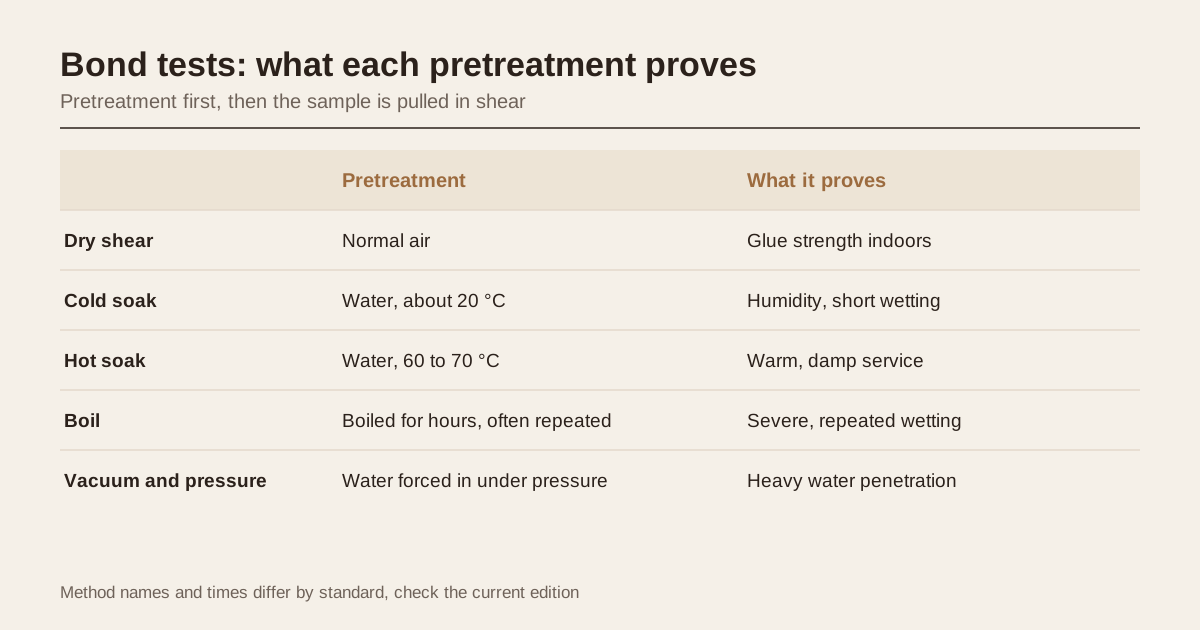
| Test | What happens to the sample | What it proves |
|---|---|---|
| Dry shear | Conditioned in normal air, then pulled | Glue strength in ordinary indoor use |
| Cold soak and shear | Soaked in water at about 20 °C for a set time, then pulled | Resistance to humidity and short wetting |
| Hot soak and shear | Soaked in hot water, often 60 to 70 °C | Resistance to warm and damp service |
| Boil and shear | Boiled for several hours, sometimes dried and boiled again | Resistance to repeated, severe wetting |
| Vacuum and pressure soak | Water forced into the sample under vacuum then pressure | Bond under heavy water penetration |
The right test follows the end use. Interior furniture panels need the dry and cold soak result. Formwork, flooring and anything outdoors needs the boil result. Asking for the boil test on a panel that will sit indoors is a cost with no benefit, and asking for the cold soak on formwork is a test that proves too little.
The standards behind the names
Test method names differ by market, and a Vietnam mill will usually test to the one its main customers use.
- European standards. The EN 314 pair covers the test method and the bond quality classes, with separate classes for dry, humid and exterior conditions. The pretreatment gets harsher with each class.
- US product standard. PS 1 sets exposure durability classes with its own soak and boil cycles, and the test is closely tied to the glue type.
- Japanese agricultural standard. JAS plywood types define their own soak and boil treatments, discussed in JAS, KS and BIS standards for plywood.
- British standard for marine panels. BS 1088 uses a long boil cycle that is among the strictest in common use, covered in marine plywood and BS 1088.
Check the current edition of any standard before you write it into a contract. Pass limits and pretreatment times are revised from time to time.
How a sample is cut
A bond test sample is not a random piece. Most methods call for small test pieces, often 25 mm wide and about 150 mm long, cut so that a single glue line is loaded. The piece is notched from both sides with saw cuts that reach the glue line being tested, which leaves a small overlap area where the failure will happen.
Where the samples are taken matters. A sensible plan takes pieces from several positions across the panel and from more than one panel in the batch, because the edges and the centre of a press load can behave differently. A report that says “one sample, one glue line” describes one corner of one panel.
Reading shear strength and wood failure
A shear result has two numbers.
- Shear strength, in newtons per square millimetre. A higher figure means a stronger bond.
- Wood failure, in per cent. It is the share of the broken surface where the wood tore instead of the glue releasing.
The numbers work together. A strong glue line leaves the weakest link in the wood, so the break runs through the wood and wood failure is high. A weak or under-cured line breaks at low force and leaves a clean glue surface, so wood failure is low.
Several standards accept a lower shear strength if wood failure is high enough, and require high strength where wood failure is low. In the European method, for instance, the required wood failure falls as shear strength rises, and above a certain strength no wood failure is needed at all. Always read the pass rule in the standard and not just the word “pass” on a certificate.
A sample report, line by line
Imagine a report for an 18 mm eucalyptus core panel with phenolic glue, tested after a boil pretreatment. It lists ten pieces, each with a shear strength and a wood failure value. The mean shear strength sits comfortably above the lowest accepted value, and the mean wood failure is high. Two of the ten pieces show low wood failure and strength close to the limit.
A careful reader does not stop at the mean. The two weak pieces tell you something about the batch. Perhaps they were cut from the edge of the sheet, where the press runs cooler. Perhaps one glue line in the stack got less glue. The mean passes and the spread says the process has a weak spot. A mill that sees this in its own report corrects it. A buyer who sees it can ask for more samples from the edge of the panel before shipment.
Note also which glue line each piece loaded. A five-ply panel has four glue lines, and a report may test only the outer ones, which are the easiest to bond. The centre lines get the least heat in the press, and a complete test samples them too.
Common reasons a bond test fails
The test itself rarely lies. A failure usually points to one of a few causes:
- Under-cured glue from a short or cool press cycle, covered in plywood hot press cycles
- Wrong glue for the class, for example urea glue tested under a boil
- Starved joints from too little glue spread, or veneer so dry it absorbed the glue
- Too long an assembly time, which dries the glue before the press closes
- Veneer surface problems, such as oily or contaminated wood, or very rough lathe checks
A mill that reads a failure report this way can fix the cause. A mill that only retests until one batch passes has not learned anything.
Why a pass can still mislead
A passing bond test is useful and it can still hide problems. Five checks keep it honest.
- Batch link. Does the report name the production date or batch of the panels you are buying?
- Glue named. Does the report say which glue was used, so you can see it matches the glue in your order?
- Pretreatment matches use. A cold soak report does not prove a boil result.
- Laboratory identity. Does the report come from a laboratory with a stated address and method list, or is it a summary page with no details?
- Thickness. Bond behaviour changes with thickness, so a report on 9 mm panels says little about 18 mm.
A report that fails any of these is not worthless. It simply needs a follow-up question before it counts as evidence.
A cheap check at the receiving dock
A full lab test is the proper evidence. At the receiving dock a simple version helps catch gross problems.
- Cut a 100 mm square from a panel and note the glue line colour on the edge. The colour link to glue type is explained in MR, melamine or WBP plywood glue.
- Boil it for four hours, dry it and look for plies lifting at the edge.
- Try to peel a ply from the edge with a chisel. Wood tearing means a good bond. A clean glossy ply surface under the veneer means a poor one.
This does not replace a laboratory result. It will stop you from accepting a panel that obviously delaminates, and it gives you evidence to attach to a claim. How to handle a claim is covered in plywood defects on arrival.
Writing the bond into the order
Four lines are enough:
- Glue type by name and the bond class or exposure rating wanted
- The test standard and its current edition
- Samples drawn from the production batch, with the number of panels stated
- A right to have a third party draw and test the samples before shipment
Closing checklist
- End use decided, and the matching pretreatment chosen
- Standard and pass rule named in the order
- Report linked to the production batch
- Wood failure reported, not only strength
- Receiving dock check planned for the first container
Send your specification through the enquiry form and mills that already press that product will quote against the bond class you name.
Frequently asked questions
What is the difference between a boil test and a shear test?
A boil or soak test is a pretreatment that stresses the glue line with water and heat. A shear test pulls the glue line apart in a machine and measures the force. Most standards combine them: the sample is conditioned in water first, then loaded in shear while still wet or after drying.
Does a boil test result apply to the whole shipment?
Only to the batch the sample came from. A test report on a panel pressed last month says little about the container you are buying today. Ask for the test on a panel from your production run, or have a third party cut samples at loading.
What is wood failure and why is it reported?
Wood failure is the share of the broken surface where the wood tore instead of the glue letting go. High wood failure means the glue line was stronger than the wood beside it, which is the result you want. Low wood failure with low strength points to a weak or under-cured bond.
Need a quote for this panel?
Send the specification. We match you with up to 3 Vietnam mills and answer within 24 business hours.
Get matched with a mill