Guides / Specification
Hot Press Cycles: How Time, Heat and Pressure Set the Bond
October 22, 2026
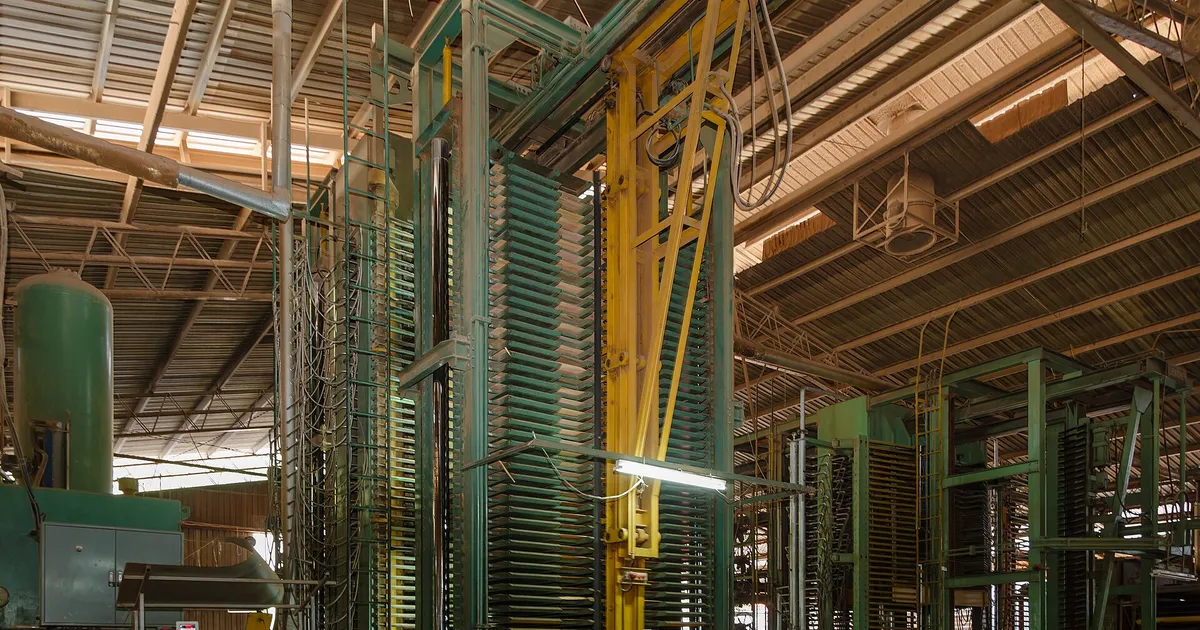
The hot press is where plywood becomes plywood. Before the press, a stack of veneers wet with glue is just a stack. After it, the glue has cured under heat and pressure into a bond line that has to survive weather, loads and years in a warehouse.
Most bond complaints trace back to this one step. A panel can have excellent veneer and the right glue on paper, and still fail because the cycle was short, cold or wet.
What the press does
Three things happen at once inside a hot press.
- Heat travels from the steel platens through the veneer stack to the glue lines and starts the cure reaction.
- Pressure squeezes the veneers into contact, flattens small differences in thickness and pushes glue into the wood surface.
- Time gives the heat the minutes it needs to reach the centre of the stack and finish the cure there.
The centre glue lines of a thick panel are the last to cure, because they are furthest from the platens. A panel that looks fine on the face can have an under-cured core line. That is why press time scales with thickness, not with the number of sheets in the press.
Typical numbers by glue type
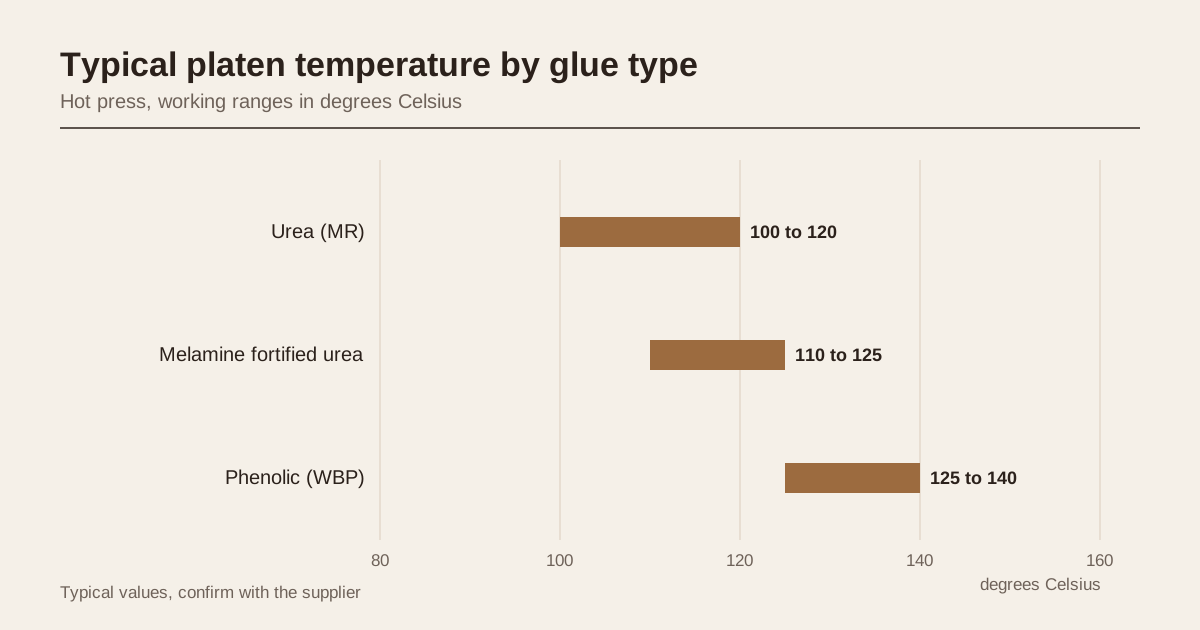
Mills in Vietnam press with urea, melamine fortified urea and phenolic glue, and each wants a different cycle. The figures below are typical working ranges. Each mill sets its own, and the glue supplier’s data sheet decides the final numbers.
| Glue | Platen temperature | Specific pressure | Typical use |
|---|---|---|---|
| Urea (MR) | 100 to 120 °C | 1.0 to 1.2 MPa | Interior panels, packing |
| Melamine fortified urea | 110 to 125 °C | 1.0 to 1.3 MPa | Humid interior, furniture |
| Phenolic (WBP) | 125 to 140 °C | 1.1 to 1.4 MPa | Formwork, exterior, flooring |
Hardwood veneers need more pressure than softwood to close the surface. A cold pre-press before the hot press helps the stack hold together while it is loaded, and it is common practice. The glue types themselves are explained in MR, melamine or WBP glue.
A worked example, 18 mm phenolic panel
Take a panel pressed at 135 °C with phenolic glue, and assume 40 seconds per millimetre as an illustration. The glue needs 12 minutes under full heat and pressure. Add two minutes to load and close the press and two to decompress and unload, and one opening of the press is busy for about 16 minutes. A press that runs without a break completes under four loads an hour.
Now halve the press time to save money. The surface of the panel looks the same, the sheets stack the same and the first bond test on the outer glue lines may pass. The centre lines are the ones that suffer, and they only show up in a boil test or on the day the panel meets water. A shorter cycle is the cheapest saving a mill can make, and it is almost impossible to see.
The same arithmetic explains why thick panels cost more per square metre than the veneer alone suggests. Press time grows with thickness, so a 25 mm panel occupies the press for much longer than a 9 mm panel, and the press is the bottleneck of the mill.
Where time goes
Press time is not only cure time. A full cycle has four parts:
- Loading and closing, the minute or two while the press fills and the platens come together
- Pressing under full pressure and heat, the part that cures the glue
- Decompression, when the pressure and the steam are released
- Unloading, after which the panels are stacked to cool and settle
Decompression gets rushed more than any other stage. The veneer carries some moisture, the heat turns it into steam, and the steam has to leave through the edges. If the press opens fast, the steam is still inside and pushes the layers apart. The result is a blow, a bubble or split inside the panel that may not show until the panel is sanded or cut.
The four common failures
Every one of these is a press problem before it is a material problem.
| Failure | What it looks like | Usual press cause |
|---|---|---|
| Under-cured glue line | Plies separate in a boil test, glue smears under a knife | Time too short or platen too cool |
| Blow or steam pocket | Bubble, soft spot or internal split | Wet veneer or fast decompression |
| Glue bleed-through | Dark stains on the face veneer | Too much glue, too much heat or pressure on thin faces |
| Thickness loss | Panel thinner than ordered | Too much pressure on a soft core |
Blows and under-cured lines are the two that matter for a buyer. A bond test will find an under-cured line, as described in plywood bond tests: boil, soak and shear. A blow shows up as a dull sound when the panel is tapped, and as a soft or raised patch.
Single opening and multi-opening presses
Large mills press many panels at once in a multi-opening press, often called a multi-daylight press. Platens stack like shelves, and each gap holds one or more loaded panels. The press loads all the openings together, closes together and releases together. This is efficient, and it makes consistency the real question. Platens at the top and bottom of the stack can run at slightly different temperatures from the middle, and a loading mistake on one opening shows up on every panel in it.
Smaller mills use single-opening or few-opening presses. They load more slowly and run fewer panels per hour, yet each panel gets a cycle that is easier to monitor. Neither type is better by itself. What matters is whether the mill knows its own temperature spread across the platens and checks it.
Reading a press record
A press record is a short log that a mill with a controlled process already keeps. It lists the date and shift, the product code, the glue and its mix, the platen temperature, the pressure, the press time and the number of panels in the load. Many mills keep the record on a whiteboard or in a notebook beside the press, and a few use data loggers.
For a buyer the record has one use: it links a panel in your container to a cycle that was run on a particular day. If a bond test later fails, the record tells the mill whether the failure was one load, one shift or the whole week. A mill that cannot link a failure to a cycle cannot correct it either.
What affects the cycle before the press
The best press cycle in the world cannot fix a poor stack. Four inputs decide how much margin the cycle has:
- Veneer moisture. Very wet veneer produces steam and long cycles. Very dry veneer pulls moisture from the glue and gives a starved joint. The target range is covered in veneer drying and plywood moisture content.
- Glue spread and mix. Too little glue starves the joint. Too much slows the cure and bleeds through. Spread is set in grams per square metre and checked by weighing.
- Assembly time. The minutes between spreading glue and closing the press. Long waits let the glue surface dry out and weaken the joint.
- Stack quality. Veneer thickness variation and core gaps mean some areas get less pressure than others.
Ask a mill how it checks these four. A mill with a record of glue spread, veneer moisture and press settings is a mill that can reproduce a result on the second order.
One press or two
Some panels go through the hot press twice, once to make a base panel and once to add the face. That changes cost, flatness and surface quality, and it has its own guide: one time vs two time pressed plywood.
Questions to put to a mill
You cannot stand beside the press, but the answers to a few questions tell you most of what you need:
- Which glue do you use for this product, and what is the platen temperature and press time for this thickness?
- What is the veneer moisture range going into the press, and how is it measured?
- Do you press this thickness in a multi-opening press, and how many panels per opening?
- Can you send the press record and the bond test result for a recent batch of this product?
- What is the decompression time, and how do you stop blows?
A mill that answers with numbers is controlling the process. A mill that answers “our press is very good” is describing a machine, and the machine is only half of the process.
A short specification line
Put the bond into the enquiry in words that can be checked:
- Glue type by name, such as “phenol formaldehyde, WBP”
- Bond test standard and the pass criterion
- A statement that the bond test is run on a panel from the production batch, not a one-off sample
- Right to reject a shipment that fails an independent test
A third party can run the test at the mill before loading, which is covered in pre-shipment inspection for plywood.
Closing checklist
- Glue type and press temperature stated for your thickness
- Veneer moisture range agreed before pressing
- Press record available for your production batch
- Bond test report from the same batch, not an older one
- Decompression and blow control described in the quote
- Inspection booked before the container is loaded
If you have a specification and want to see which mills already press that product, send it through the enquiry form and we pass it to up to three Vietnam mills.
Frequently asked questions
How long does plywood stay in the hot press?
Press time depends on glue, panel thickness and platen temperature. As a typical range, a phenolic bonded panel needs roughly 30 to 60 seconds per millimetre of thickness at working temperature, and urea based glues need less. A mill that cannot tell you the cycle for your thickness is guessing.
What is a blow in plywood?
A blow is a pocket of steam that bursts the glue line when the press opens, leaving a bubble or a split inside the panel. It usually comes from veneer that was too wet, or from opening the press too fast. It is often invisible from the outside until the panel is sanded or cut.
Can a buyer see the press cycle?
A buyer can ask for the press record of the production batch: platen temperature, pressure, press time and the date. A mill with a controlled process keeps this. It is a better question than asking whether the mill has a good press.
Need a quote for this panel?
Send the specification. We match you with up to 3 Vietnam mills and answer within 24 business hours.
Get matched with a mill