Guides / Specification
Commercial or Structural Plywood: What the Label Has to Prove
October 6, 2026
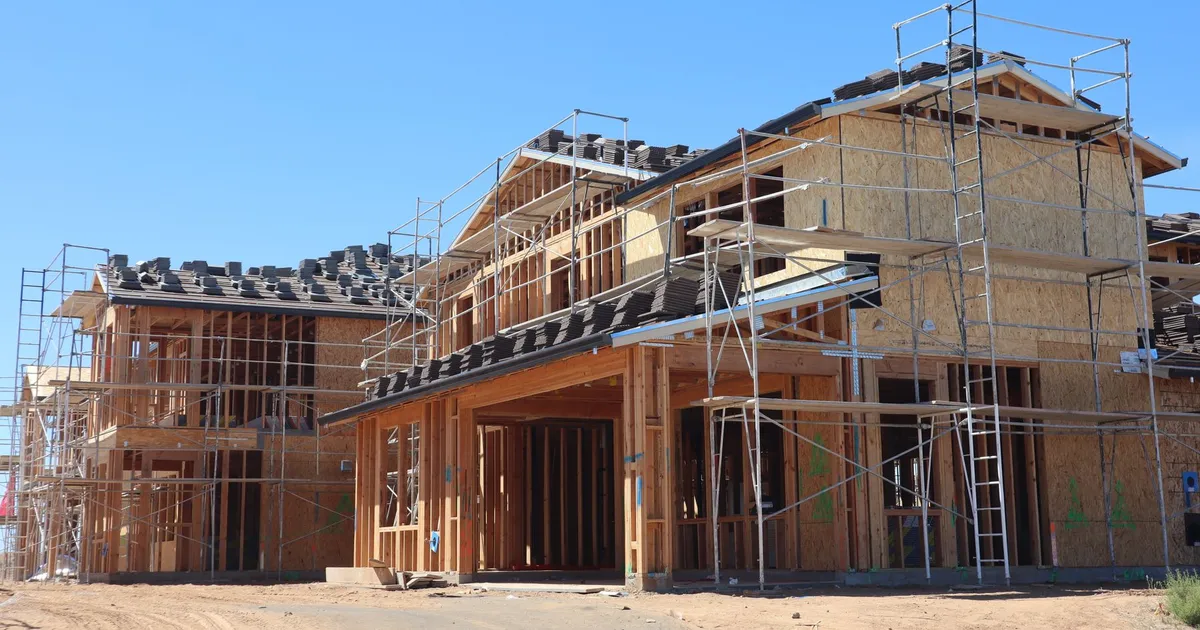
A building inspector does not care what a mill calls its plywood. The inspector looks for a standard, a grade mark and a set of documents. If the panel has them, it is structural. If it does not, it is a commercial panel, however strong it is.
That is the essence of the difference. Strength alone does not make plywood structural. Evidence does.
What commercial plywood is
Commercial plywood is the general-purpose panel that makes up most of what is traded. Its quality is described by appearance, thickness, glue type and a handful of general properties. It is used where no calculation depends on the panel’s strength.
- Packing and crates
- Furniture and cabinet panels
- Interior linings and fixtures
- Hoardings and temporary works
- Formwork, where the buyer judges the panel by use and pours
Commercial does not mean poor. A good commercial panel with a sound core and a phenolic bond can be strong and durable. What it lacks is a declared, checked, repeatable set of mechanical properties tied to a standard.
What structural plywood is
Structural plywood is made to a standard that sets requirements for bond, veneer quality and mechanical performance, and it is produced under a controlled system with checks on every stage. It carries a mark that connects the panel to that standard.
What defines it:
- A named standard, such as an European plywood product standard, a US voluntary product standard or a national structural plywood standard.
- A bond class suited to the exposure, typically an exterior bond for exposed use.
- Veneer grading rules that limit defects and set ply thickness and layup.
- Declared mechanical properties, bending strength and stiffness, and sometimes shear and bearing values.
- Factory production control with regular testing, and often an outside body that audits it.
- A mark or a declaration on the panel or the delivery documents.
Without items 5 and 6, a panel is a good panel with a claim attached. Buyers who need a structural panel for a building should treat the paperwork as part of the product.
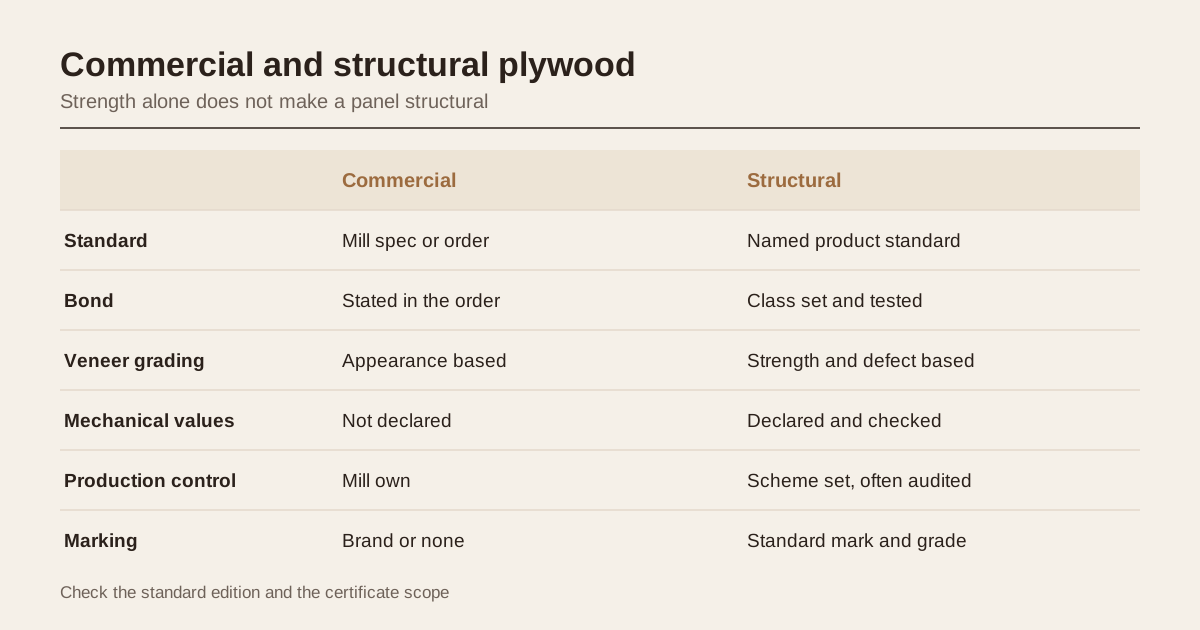
Side by side
| Item | Commercial | Structural |
|---|---|---|
| Standard | Mill specification or buyer’s order | Named product standard |
| Bond | Whatever the glue is, stated in the order | Class set by the standard, tested |
| Veneer grading | Appearance based | Strength and defect based |
| Mechanical values | Not declared | Declared and checked |
| Production control | Mill’s own | Set by the scheme, often audited |
| Marking | Brand or none | Standard mark and grade stamp |
| Typical price | Base | Higher, because of tests and control |
| Use in buildings | Non-structural | Structural, where the code allows |
Typical mechanical values, and why they are only typical
Hardwood plywood made with a good phenolic bond can reach bending strengths of roughly 40 to 60 N/mm2 along the face grain at 18 mm and around 25 to 40 N/mm2 across it, with stiffness in the range of about 5,000 to 9,000 N/mm2 along the grain. These are broad figures that vary by species, layup and glue. They give a sense of scale and they are not design values.
Design values for engineers come from the standard or from the declaration of performance, and they are lower than test averages because they include a safety margin. Never design from a mill’s brochure figure.
Standards by market
Different regions expect different documents.
- Europe. A harmonised product standard sets how plywood for use in construction is declared, including the properties, and a CE marking route applies to panels placed on the market for structural use. The exposure classes for use in dry, humid or exterior conditions are set in a companion standard, and design values come from another.
- United States. A voluntary product standard sets performance categories and exposure ratings for structural plywood, and panels carry a trademark from a recognised grading agency.
- Japan. The agricultural standard has a structural plywood category with its own tests and grading.
- Elsewhere. Many countries refer to one of the above or to their own national standard.
The Japanese and Korean schemes are covered in JAS, KS and BIS standards for plywood. Always check the current edition of the standard and the current rules at your destination before you rely on any description in this article.
How veneer is graded for strength
In a commercial panel, veneer grade is about looks: how many knots, patches and colour changes show on the face. In a structural panel the grade is about strength. Knots and slope of grain weaken a veneer, and a structural standard limits them in every layer, not only on the face.
Three rules follow from this:
- Inner plies count. A clean face over a core of weak veneer is a commercial panel. A structural standard sets limits for the core too.
- Balanced layup. Veneers of similar thickness and species sit symmetrically about the centre, which keeps the panel flat and its strength predictable.
- No open gaps. Gaps in the core reduce shear and bearing strength, and a structural standard limits their width and number.
A visual check helps. Cut an edge and look at the layers. Even thickness, tight joints and no voids point to a controlled build. Uneven plies, open gaps and patches of different species point to a commercial one.
Why the bond class is part of the label
Structural panels used outside or in damp conditions need an exterior bond, which in practice means phenolic glue pressed and cured correctly. A structural panel with a weak glue line is a contradiction in terms, because its strength values assume that the layers stay bonded for decades.
For that reason the bond test is never optional on a structural order, and it should be linked to the production batch. The three glue families are explained in MR, melamine or WBP glue.
Thickness, span and design tables
A structural panel is chosen from tables in the standard or in the engineer’s design. The tables relate panel thickness, support spacing and load. A thicker panel spans a longer distance, and a panel with a higher strength class can carry more over the same span.
The practical lesson for a buyer is that thickness tolerance matters more on structural orders. A panel sold as 18 mm that measures 17.2 mm has less stiffness than the design assumed, and stiffness depends strongly on thickness. Tolerance rules for plywood are covered in plywood sizes and tolerance. Write the minimum acceptable thickness into the order.
Marks, stamps and verification
A grade stamp on a panel tells an inspector who certified it. It is also something that can be copied. Buyers and inspectors should verify marks, not just look at them.
- Ask for the certificate and check that the scope covers the product, thickness range and glue type you ordered.
- Contact the certifier to confirm that the certificate number is valid, since most bodies keep a list of holders.
- Check the mark on the panel against the certificate: the mill code, the standard and the year should match.
- Keep photos of marks on the delivered panels with the lot number.
A mill that holds certification welcomes these checks. A mill that avoids them has told you something.
What a mill can claim
A mill can say what it has done and show the evidence. It cannot say a panel is structural because the mill believes it is. Three situations are common.
- The mill holds a recognised certification for a structural standard and can show the certificate and the scope. The panel is marked and documents come with it.
- The mill tests panels to a structural standard in its own or a third-party laboratory, without a certification scheme. The report supports a technical claim and does not give you a certified product.
- The mill sells a commercial panel and describes it as suitable for structural use. This is a sales statement, and it does not meet a building code.
A buyer should ask which of the three applies. Do not assume that any Vietnam mill or product is certified. The site you are reading is a matching service and does not certify anything. Each mill must show its own documents.
Questions to ask
- Which standard is this panel made to, with its edition year?
- Is the production certified by an outside body, and can you send the certificate and its scope?
- Which laboratory tested bending, shear and bond, and when?
- What marks or labels does the panel carry?
- What documents ship with each lot?
When a commercial panel is the right answer
Structural plywood is the wrong purchase when nothing is structural. A paid-for test on a panel that becomes a shop counter is waste. A commercial panel with a good phenolic bond, a sound core and clear thickness tolerance does the job. For heavy-duty commercial uses, such as formwork and flooring, the better route is a sound spec: phenolic glue, a gap-free hardwood core and a bond test report. See plywood bond tests: boil, soak and shear.
When you really need structural
Structural is the right product when:
- an engineer’s design depends on the panel’s strength
- a building code requires a marked panel
- the panel is a bracing, sheathing, flooring or roof element
- insurers or authorities will ask for documents
In these cases, put the standard and the document requirements in the enquiry, and expect a longer lead time and a higher price.
Closing checklist
- Decide whether any design or code depends on the panel
- Name the standard and its edition in the enquiry
- Ask for the certificate, its scope and the issuing body
- Ask for test reports on bending, shear and bond, linked to the batch
- Check the marks on a sample before the order is confirmed
- Keep documents with the shipment for authorities and inspectors
Send the standard and the end use through the enquiry form, and up to three Vietnam mills will say which documents they can supply.
Frequently asked questions
What makes plywood structural?
A panel is structural when it is made and tested to a standard that sets bond class, veneer grading and mechanical properties such as bending strength and stiffness, and when it carries the marking that links it to that standard and to a controlled production process. The word structural alone on a quote proves nothing.
Can commercial plywood be used for structural work?
Not where a building code or an engineer requires a declared strength. Commercial plywood has no declared mechanical properties and no assured bond class unless the order says so. It is used for non-structural parts such as hoardings, packing, furniture and interior linings.
Do Vietnam mills make structural plywood?
Some mills press panels intended for structural or semi-structural uses, and what they can legitimately claim depends on the standard, the testing and the factory control behind it. Ask which standard the panel is made to, who tested it and what documents come with the shipment, and do not accept the word structural as a spec.
Need a quote for this panel?
Send the specification. We match you with up to 3 Vietnam mills and answer within 24 business hours.
Get matched with a mill