Guides / Specification
Plywood for Laser Cutting: Core, Glue and Thickness That Cut Clean
October 15, 2026
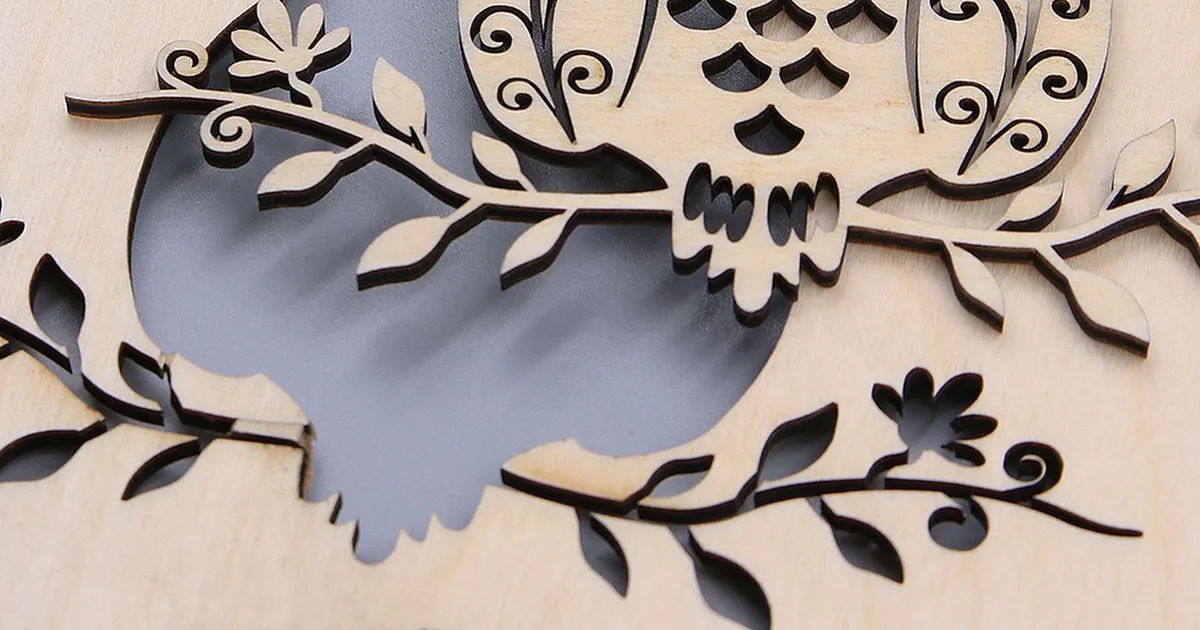
A laser cut is a precise operation on a variable material. The machine does the same thing every time, and the plywood differs from sheet to sheet. A void in the core burns differently from solid wood. A thick glue line chars. A warped sheet moves out of focus. Most failed laser jobs turn out to be panel problems, not machine problems.
Craft, signage, model, packaging and furniture makers who laser cut plywood in volume learn this quickly. The panel specification is short, and each line has a clear effect on the cut.
What a laser does to plywood
A CO2 laser focuses a beam onto the surface and burns away a narrow line of wood. The beam vaporises the wood and any glue in its path, and air assist blows the smoke and debris out of the cut. Four things decide the result.
- Power and speed, which set how deep the cut goes and how much heat spreads sideways
- Focus, which sets how narrow the cut is and depends on a flat sheet
- Material, the species, density, glue and moisture
- Air assist and extraction, which clear smoke and reduce flaring
The panel controls the third, and indirectly the second. Of the four, it is the one a buyer can specify.
Panel features that matter
| Feature | Why it matters to the laser | What to ask for |
|---|---|---|
| Flatness | A bowed sheet drifts out of focus and cuts unevenly | Maximum bow in millimetres per metre |
| Even thickness | Variation changes cut depth and joint fit | Tolerance of 0.2 mm or better, calibrated sanding |
| Gap-free core | Voids flare, leave burnt holes and break parts | Void-free core, thin plies |
| Light, even species | Dense or resin-rich wood chars and slows the cut | Poplar, birch or similar, with a stated species |
| Glue type | Glue lines burn differently from wood | Named glue, tested on a sample |
| Moisture | Wet panels cut slowly and char more | Moisture range stated |
| Clean faces | Marks and dust show on the engraved parts | Sanded, dust-free faces |
Thickness and ply count
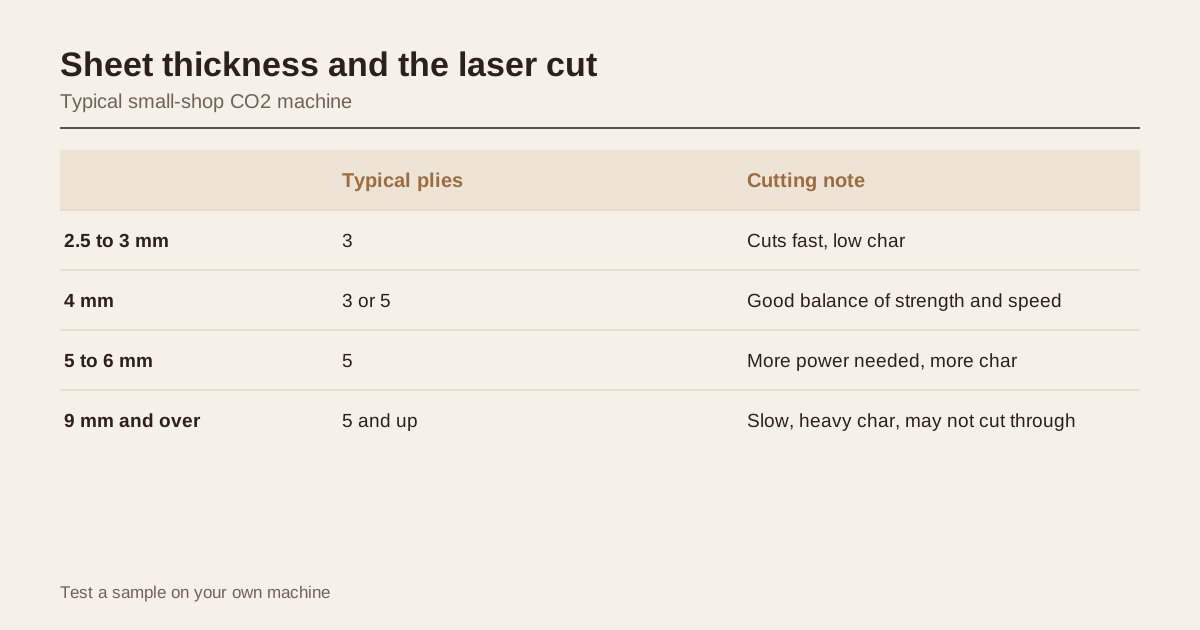
Laser plywood is usually thin. At 3 mm a typical CO2 hobby or small-shop machine cuts in one pass. At 6 mm it needs more power or a slower speed, and at 9 mm and above many machines need several passes or cannot cut cleanly.
| Thickness | Typical plies | Typical use | Cutting note |
|---|---|---|---|
| 2.5 to 3 mm | 3 | Model parts, signs, ornaments, inlays | Cuts quickly, low char |
| 4 mm | 3 or 5 | Boxes, puzzles, small furniture parts | Good balance of strength and speed |
| 5 to 6 mm | 5 | Display stands, lamp parts, larger models | Needs more power, more char |
| 9 mm and over | 5 and up | Rarely laser cut | Slow, heavy char, may not cut through |
More plies mean thinner veneers and more glue lines, which gives a stronger, flatter sheet. Thin veneers also hide core gaps better. The trade-off is more glue in the cut and a little more char. A sheet with fewer, thicker plies cuts with less glue, and it is more likely to hide a void. For decorative engraving, a clear, even face matters as much as the cut. The details of thin panels are in thin plywood from 2.5 to 6 mm.
Glue and the cut edge
Glue changes how the edge looks.
- Urea based glue usually burns relatively cleanly and leaves a light edge, with moderate smoke.
- Phenolic glue forms darker, harder glue lines that can cut slower and leave more char, and gives a strong, water resistant panel.
- Thick glue lines char and leave a sticky residue.
- Uneven glue spread gives patches that cut differently along the same line.
Ask the mill to name the glue and try a sample. A panel that cuts clean with one machine and one setting is a good panel for that shop. The glue families are explained in MR, melamine or WBP glue.
Voids and flaring
A void in the core is a hole. The laser reaches it and the beam passes through the air gap, then hits the next veneer from a different distance. The air in the void feeds the flame, and the cut can flare, leaving a burnt scar or a hole that spoils a part. In a small part, a void can break the part off its tab.
Void-free cores are the single biggest improvement a mill can make for a laser user. They cost more, because the mill sorts, patches and presses the core carefully, and they pay back in fewer scrapped parts. The core and the grading of face veneers are covered in plywood grades explained.
Poplar, birch and other species
The species sets the weight, the colour and the cut behaviour.
- Poplar is light and even, and cuts easily with low char. A common choice for craft and model sheets, as in poplar core or hardwood core plywood.
- Birch gives a pale, fine-grained face with strong thin plies. It cuts well and costs more.
- Eucalyptus and acacia give a denser, more varied panel that cuts slower and chars more.
- Rubberwood is pale and even and cuts well when the core is sound, as in rubberwood plywood from Vietnam.
The face species also decides how engraved designs look. Light, even woods give high contrast with a dark engraving. Streaky woods give a busier result.
Kerf, thickness and joint fit
A laser removes a thin strip of wood, called the kerf, usually in the range of 0.1 to 0.3 mm depending on the machine and the focus. Designers of press-fit and slot-together parts subtract the kerf and a small allowance from the slot width so the joint grips.
Here is why thickness tolerance matters. A designer draws a slot for a nominal 3 mm sheet. If the sheet measures 3.0 mm the joint fits snug. If the sheet measures 2.8 mm the slot is 0.2 mm too wide and the part is loose. If the sheet measures 3.2 mm the part will not go in without sanding. A tolerance of 0.2 mm on 3 mm panel is a difference of nearly 7 per cent, which is large for a tight joint.
A shop that cuts the same design every week learns the thickness of the supplier’s panel and tunes the design to it. A change in thickness between batches breaks every joint. That is why laser users ask for a tolerance and not a nominal thickness, and why they keep a reference caliper reading for each delivery. The rules for tolerance are in plywood sizes and tolerance.
Sheet size for the machine
A full 1220 x 2440 mm sheet does not fit most laser beds. Typical hobby and small-shop machines have beds in the range of 300 x 200 mm up to 900 x 600 mm, and industrial machines go larger. Shops cut full sheets down to bed size, which creates waste and extra handling.
Mills can supply panels pre-cut to common bed sizes, such as 600 x 400 mm or 610 x 305 mm, packed flat in cartons. Pre-cut panels cost more per square metre, and they save labour and dust at the shop. For a high-volume user the saving is real. Ask the mill for the cut tolerance, since a panel that is out of square wastes laser bed space.
Protecting the face from smoke
Laser smoke leaves a brown haze on the surface around the cut, especially on pale woods. Shops use three methods to protect the face.
- Masking tape or transfer paper over the face, removed after cutting, which keeps the surface clean
- Air assist set high, which blows smoke away from the cut
- A light sanding or wipe after cutting, which removes the haze and any residue from the cut edge
Masking tape bonds better to a smooth, dust-free surface. A panel with a rough face or surface dust pulls up and leaves marks. A clean, calibrated-sanded face works better, as set out in calibrated sanding and plywood flatness.
Flatness and storage
A warped sheet is a problem in a laser bed because the focus changes across the sheet. Sheets stored on edge or unwrapped in humid air bow quickly.
- Store sheets flat, on a level pallet, wrapped, with a board on top.
- Keep them in the workshop climate for a few days before cutting.
- Use a honeycomb bed or pins that hold the sheet flat while it cuts.
- Check flatness with a straight edge before loading a large job.
Moisture matters too. A panel that has taken on water cuts slower and chars more. The moisture range should be set in the order, as in veneer drying and plywood moisture content.
Smoke, formaldehyde and extraction
Laser cutting burns wood and glue, and the smoke contains organic compounds, including formaldehyde. A properly designed extraction system that vents outside is a safety requirement. Use the machine maker’s guidance and local rules. A low-emission panel gives less formaldehyde in the smoke, and it is a sensible choice for shops that cut all day. The classes are explained in E0, E1 and CARB P2 compared.
A sample test before you buy
A short test saves a pallet of problems. Ask for three sheets from the production line and run five checks on your own machine.
- Cut a test grid of squares, slots and fine details at your normal settings.
- Check the edge for char, residue and flare.
- Measure thickness at several points and compare joint fit.
- Measure bow across the sheet.
- Try an engraving on a face area, and look for patches, resin spots or glue showing through.
Keep the sheets and the settings as the reference. If a later batch cuts differently, the reference shows which parameter changed.
Writing it into the order
- Thickness and tolerance, with a calibrated sanding requirement
- Ply count and a void-free core, or a gap limit
- Species of face and core
- Glue type and emission class
- Flatness limit and moisture range
- Sanded faces and dust-free finish
- Sheet size, packing flat and wrapped
Closing checklist
- Choose thickness by the thickest cut your laser makes cleanly
- Ask for a void-free core and thin, even plies
- Test the glue on your own machine
- Check flatness and thickness spread
- Store flat and acclimatise before cutting
- Vent smoke outside, always
- Keep a reference sheet and the settings
Send the sheet size, thickness and quantity through the enquiry form, and up to three Vietnam mills that press fine panels will quote.
Frequently asked questions
What plywood cuts best with a laser?
Flat sheets with an even thickness, a gap-free core made of thin plies, a light, even species and a glue that burns cleanly. Panels of 3 mm to 6 mm with three to five plies are the usual choice. Test a sample on your own machine, since laser type and power change the result.
Why does my laser cut leave dark, sticky edges?
Resin and glue burn and leave char and residue on the cut edge. Slow cuts, thick sheets and resin-rich wood make it worse. Air assist, a faster pass, clean optics and a lighter, more even core cut cleaner. Sanding or a light wipe removes the rest.
Is laser cutting plywood safe?
Cutting produces smoke that contains the products of burning wood and glue, including formaldehyde and other compounds, so a working extraction system that vents outside is essential. Follow the machine maker's instructions and local rules. Panels with low formaldehyde emission are a sensible choice.
Need a quote for this panel?
Send the specification. We match you with up to 3 Vietnam mills and answer within 24 business hours.
Get matched with a mill