Guides / Specification
Melamine Faced Plywood: Papers, Colors and What to Check
October 16, 2026
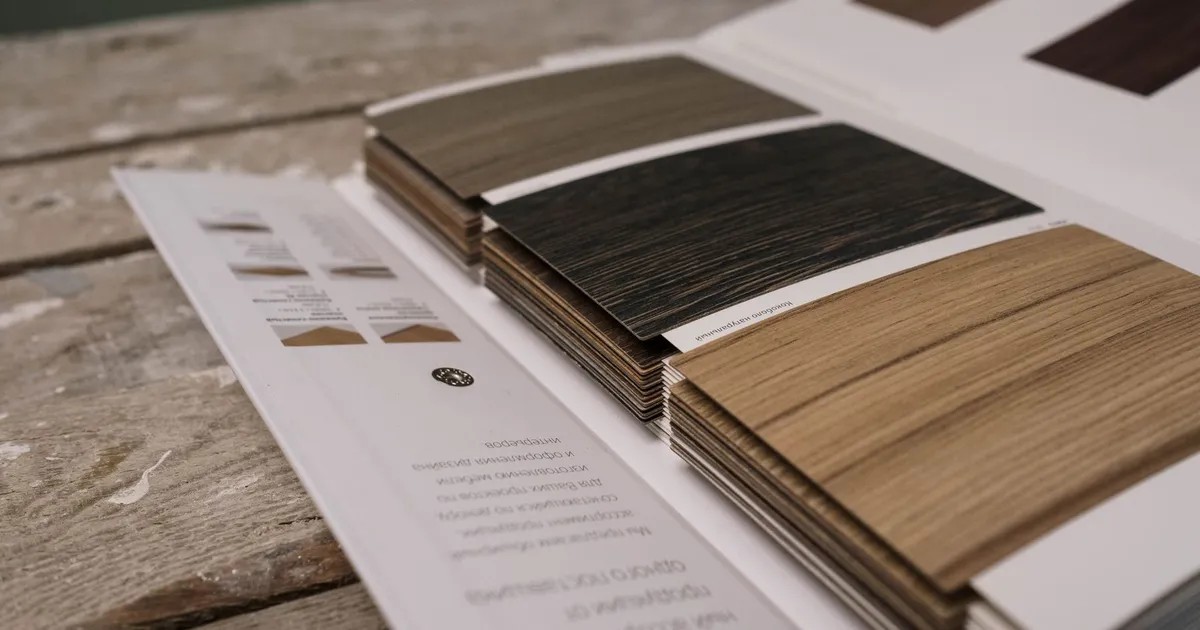
Walk into a kitchen showroom and most of what you see is a printed paper. It sits on a board, covered in a thin layer of cured resin, and a customer touches it and sees wood, stone or a flat colour. Melamine faced plywood is one version of this surface, laid on a plywood core instead of particleboard or MDF.
The surface brings its own list of choices: paper weight, colour, texture and the way the paper is pressed. Most quotes mention colour and nothing else.
What melamine faced means
The face is made in three steps.
- Decor paper is printed with a colour or a pattern.
- Impregnation. The paper is soaked in melamine formaldehyde resin and dried to a controlled level.
- Pressing. The paper is laid on the panel face and pressed under heat and pressure, where the resin flows, bonds to the substrate and cures into a hard, clear skin.
The result is a surface that resists scratches, stains, moisture and many household chemicals, and that comes in a very wide range of designs. It is cheaper than a real veneer and more repeatable.
Melamine faced and melamine glue are not the same
The phrase melamine appears twice in the plywood trade, and the two uses have no connection.
| Term | What it describes | Where it is | Why it matters |
|---|---|---|---|
| Melamine faced | The decorative paper on the surface | On the face | Colour, wear, cleaning |
| Melamine glue, or melamine fortified urea | The adhesive between veneers | Inside the panel | Bond strength under humidity |
A melamine faced panel can have a cheap urea glue inside. A panel with melamine glue can have a plain wood face. The glue question is explained in MR, melamine or WBP glue. Write the glue and the surface as separate lines in the order, because the two decide different things.
Paper weights and what they do
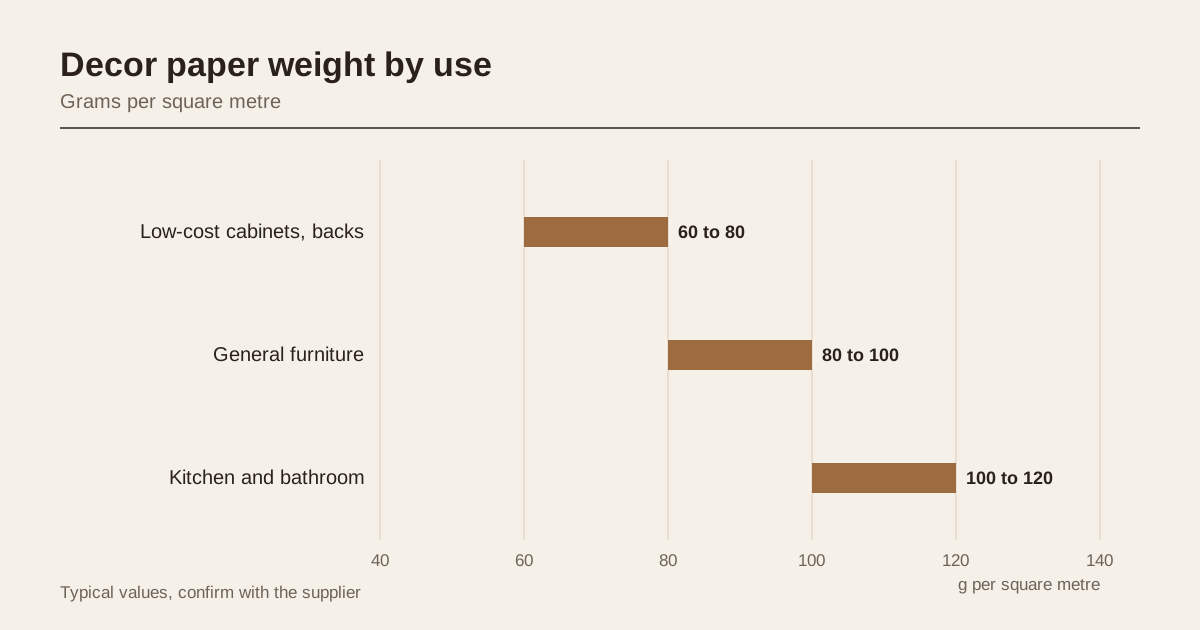
Decor papers are specified in grams per square metre. Lighter papers are cheaper and show more of the core. Heavier papers hide defects better and wear longer.
| Paper weight, g/m2 | Typical use | Behaviour |
|---|---|---|
| About 60 to 80 | Low-cost cabinets, shelving, backs | Thin, may show core texture |
| About 80 to 100 | General furniture, wardrobes | Balanced cost and cover |
| About 100 to 120 | Kitchen and bathroom cabinets, worktop-adjacent panels | Better cover and wear |
| Overlay layer over the decor | High-wear surfaces | Extra clear layer for abrasion |
These are typical ranges for decor paper in the industry, and suppliers’ ranges differ. The weight alone does not decide quality. Resin content and press conditions matter as much.
Ask for the paper weight and the supplier’s data sheet, and confirm that the value is per face. Some panels carry a heavier paper on the visible face and a lighter balancing paper on the back, which keeps the panel flat.
Colours, patterns and textures
The range is wide, and most of it falls into four groups.
- Solid colours, whites, greys, blacks and pastels, used for modern cabinets
- Wood-grain prints, oak, walnut, ash and many invented tones
- Stone and abstract prints, used for counter fronts and panels
- Special effects, such as metallic and high gloss finishes
Texture adds a second choice. The press plate that closes on the paper can leave the surface smooth and glossy, matt or embossed with a grain, a pore or a linen pattern. Embossed in register, where the texture lines up with the printed grain, looks more natural and costs more.
Ask the mill for a decor code, a texture name and a physical sample. A request for white or oak leaves too much open.
How the paper is pressed
Melamine paper goes on in a short-cycle press, a press built for fast cycles at high temperature. As a typical range, platen temperature is in the region of 160 to 200 °C, pressure is in the range of 2 to 3.5 MPa and the paper stays under pressure for tens of seconds. The heat melts the resin in the paper, the resin bonds to the panel and the cure locks in the surface.
Two press conditions drive the look of the finished face.
- Temperature and time decide how far the resin cures. Too little cure leaves a soft, cloudy surface that stains. Too much makes the surface brittle and prone to crazing.
- The press plate gives the texture. A smooth plate gives a gloss, a textured plate gives a matt or embossed finish.
A panel pressed with a paper that was stored in a damp room can show clouding, because moisture in the paper boils off in the press. Mills that store decor paper in a closed, dry room make fewer faulty panels. Ask where the paper is stored.
Sizes, thicknesses and balance
Melamine faced plywood is made in the standard sheet sizes of the trade, with 1220 x 2440 mm the most common, and in thicknesses from about 9 mm to 18 mm for furniture. The size and tolerance rules in plywood sizes and tolerance apply, and the thickness you order should state whether it includes the paper layers.
Balance matters for a flat panel. A panel with paper on one face only is held flat by the plywood, and a panel with a heavy paper on one side and nothing on the other can bow. When a panel is faced on one side, the back is often left raw, sanded or covered with a lighter balancing paper. Ask which, because a raw back accepts glue and a papered back does not.
A worked example, one wardrobe run
A maker plans 60 wardrobes using a white face in the carcase and an oak print on the doors. The carcase needs 360 sheets of 15 mm panel in white, and the doors need 120 sheets of 18 mm in oak. Two decors, two thicknesses, two paper lots.
Three order lines prevent most problems. The first fixes the decor code and the paper lot for each colour. The second asks for a retained sample of each lot, so a repeat order can be matched against it. The third asks the mill to pack each colour and thickness on its own pallet, labelled with the decor code and lot, so a mixed pallet cannot reach the assembly line. These cost nothing at the order stage and save an entire production batch if a lot differs.
Controlling colour across an order
Colour variation is the most common complaint about melamine faced panels. It happens because:
- Paper lots differ. A decor paper printed in March can differ slightly from one printed in June.
- Press conditions vary. Temperature and time shift gloss and shade.
- Substrate colour shows through, particularly in pale shades over a dark core.
Control starts with the order.
- Single lot. Ask that all panels use the same paper lot, and that the mill reports the lot number.
- Reference sample. Approve a physical sample and keep it signed.
- Tolerance. A colour difference limit, expressed in the way the market uses, such as a visual comparison under a stated light or a measured colour difference value.
- Mixed orders. If you will buy again, ask the mill to keep a retained sample of the lot.
The core under the paper
The paper is thin, and it copies whatever is under it. A core with gaps, overlaps or a rough surface shows through. For a good melamine face the plywood base needs three things.
- A flat, sanded surface, often from a two-press route, as covered in one time vs two time pressed plywood
- A gap-free core, since a gap under the paper makes a visible dent
- The right moisture, because wet panels cause blisters
Poplar and light hardwood cores are common for melamine faced panels. The choice of core affects weight, as described in poplar core or hardwood core plywood.
Typical defects
| Defect | What it looks like | Usual cause |
|---|---|---|
| Pitting or pinholes | Tiny dots in the surface | Dust or moisture under the paper |
| Telegraphing | Dents following core gaps | Poor base, thin paper |
| Blisters | Raised bubbles | Steam from a wet base |
| Cracking | Fine lines in the surface | Over-cured resin, thermal shock |
| Edge chipping | Paper breaks at the cut | Dull saw blade, poor cut |
| Colour patches | Uneven shade | Mixed paper lots, press variation |
Most of these show up on a sample. A sample cut with a normal saw blade and edge banded shows the chipping risk straight away.
Edges, cutting and edge banding
A melamine face chips when cut, especially on the exit side of a saw blade. Furniture makers use a scoring saw or a fine-tooth blade to get a clean edge. The cut edge shows the plywood layers, and most cabinet makers cover it with edge banding in a matching colour. Ask for a sample of edge banding that matches the decor, since banding and paper are made separately and rarely match perfectly.
The cut edge is also the weak point for water. Sealing the edge or banding it protects the core, as explained in edge sealing plywood before export.
Formaldehyde and compliance
The melamine paper is a resin product, and the whole panel counts for emission testing. The class depends on the glue in the core, the paper and the press. For the US market, melamine faced plywood is covered by the same formaldehyde rules as other hardwood plywood products. Check the class with E0, E1 and CARB P2 compared, and ask the mill for a report that covers the faced panel and not only the raw plywood.
Writing it into the order
- Core species, ply count, glue and thickness
- Decor code, texture and one face or both
- Paper weight per face and supplier
- Single paper lot for the whole order
- Colour approval sample and tolerance
- Emission class and the report covering the faced panel
- Edge sealing or banding requirements
Closing checklist
- Separate the melamine face from the melamine glue in the spec
- Choose the paper weight by use
- Approve a physical sample and keep it
- Ask for single-lot paper and report the lot
- Check core flatness and moisture
- Inspect a sample for pitting, telegraphing and edge chipping
Send the decor code and the end use through the enquiry form, and up to three Vietnam mills that press faced panels will quote against the same sample.
Frequently asked questions
What is melamine faced plywood?
It is plywood with a decorative paper, impregnated with melamine resin, pressed onto one or both faces under heat and pressure. The paper carries the colour and pattern, and the cured melamine gives a hard, smooth, easy-to-clean surface. The core underneath is ordinary plywood.
Is melamine faced plywood the same as melamine glue plywood?
No, and the confusion causes disputes. Melamine faced describes the surface paper. Melamine glue, or melamine fortified urea, describes the adhesive between the veneers. A panel can have either, both or neither, so write them as two separate lines.
How do I keep colour consistent across an order?
Order every sheet from the same paper lot, and ask the mill to confirm the paper supplier, decor code and lot number. Colour can differ slightly between production lots of the same decor code. Approve a physical sample before production and keep it as the reference.
Need a quote for this panel?
Send the specification. We match you with up to 3 Vietnam mills and answer within 24 business hours.
Get matched with a mill