Guides / Specification
Edge Sealing Plywood Before Export: Paint, Wax and What Each Protects
October 20, 2026
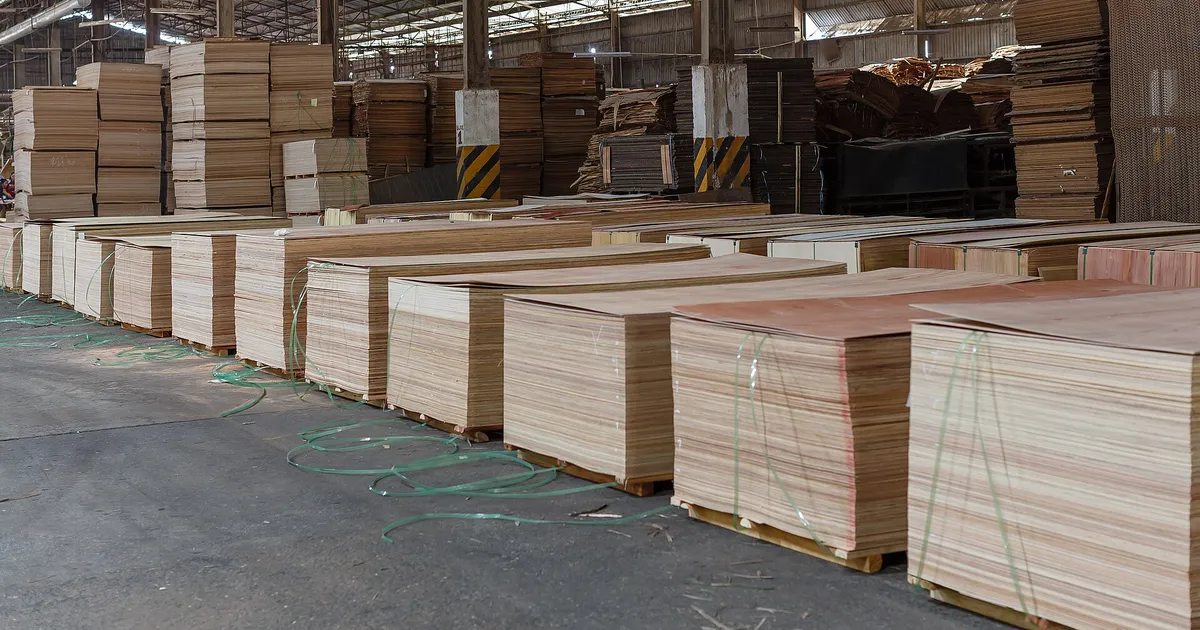
If you want to know where a sheet of plywood will go wrong first, look at its edge. The face is covered by a dense veneer, often with a film or a finish. The edge shows the end grain of every veneer, and end grain takes up water many times faster than the face.
A long sea voyage, a damp warehouse and a site with no cover all find the edge. Edge sealing is the cheapest protection available, and it is often skipped or done badly because nobody checks it.
What happens when an edge takes water
Water enters the end grain of each veneer and travels inward along the cut vessels. Three problems follow.
- Edge swelling. The edge grows thicker than the middle of the panel, and a panel that was flat in the container now has a raised rim.
- Glue line stress. Repeated wetting and drying stresses the glue lines at the edge, which is where delamination begins.
- Mould and staining. Damp end grain is where fungi start, and it spreads to the face over time.
For formwork the same edge holds the load of every pour. A panel with swollen, soft edges leaks cement paste, marks the concrete and fails earlier than the film or the core would suggest. How many pours a panel gives is influenced by this, as covered in film faced plywood from Vietnam.
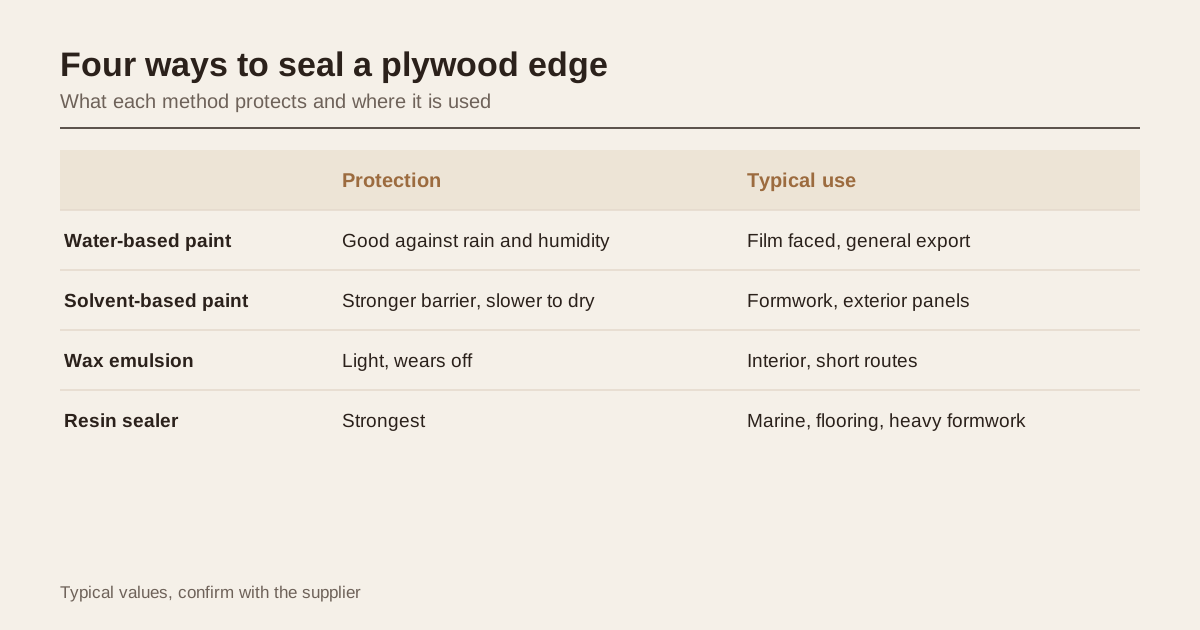
Four ways to seal an edge
| Method | What it is | Protection | Typical use |
|---|---|---|---|
| Edge paint, water-based | Acrylic coat, one or two layers | Good against rain and humidity | Film faced, general export |
| Edge paint, solvent-based | Enamel or oil-based coat | Stronger barrier, slower to dry | Formwork and exterior panels |
| Wax emulsion | Thin wax layer sprayed or rolled on | Light, wears off | Interior, short routes |
| Resin or sealer | Phenolic or epoxy based edge sealer | Strongest | Marine, flooring, heavy-use formwork |
Edge paint comes in colours. Many mills use red, brown or black to mark film faced panels and sometimes to show the grade or the glue type, though the colour on its own proves nothing about the product. Check the paint, not the colour.
How many coats and how thick
A single thin coat of paint is better than nothing and not much better. What counts is a continuous film over the whole edge, including the corners.
- Two coats are the working standard for sea freight. The second coat covers pinholes in the first.
- Coverage is usually stated in grams per square metre of edge area, and suppliers’ data sheets give the right range.
- Drying time matters. Stacking panels while the paint is wet sticks sheets together and leaves marks.
A mill that sprays edges on a conveyor controls coverage better than one that brushes them by hand. The coating line is a good question to ask when you visit or when you request photos.
How a coating line should look
A mill that seals edges well usually does it on a line and not by hand. Sheets are stacked or conveyed so that the edges face a spray head or a roller. A line gives an even coat and covers all four edges at a steady speed. A hand brush gives a good coat on the first sheet and a poor one on the hundredth.
When you ask for photos, look for three things: the edge colour is even from end to end, the paint reaches the corners and the sheets are stacked with spacers or are dry before stacking. Drips running down the face, bare corners and sheets stuck together by wet paint are all signs of a rushed job.
A simple edge soak test
If edge protection is critical, for example on formwork, you can check it. Cut three small samples from a sealed panel, about 100 mm square, with one cut edge left bare as a control. Measure the thickness at the edge with a calliper, place the samples edge-down in 5 mm of water for 24 hours, dry the surface with a cloth and measure again.
The sealed edges should swell far less than the bare edge. A sealed edge that swells almost as much as a bare edge has a coating that is too thin or missed the end grain. The test costs a few minutes and tells you more than a data sheet. Record the numbers and keep the samples, because they are good evidence if the shipment is later disputed.
What sealing does not do
Sealing has limits, and a buyer who expects more than it can give will be disappointed.
- It does not make an MR bonded panel waterproof. The glue lines still fail under repeated wetting, as described in MR, melamine or WBP glue.
- It does not protect the face of an unfilmed panel.
- It does not last forever. Paint wears at corners, cracks when panels flex and is cut away when the panel is trimmed on site.
- It does not replace a dry store. A sealed edge slows water and does not stop it for weeks of standing wet.
Cut edges made at the site, where you trim a panel to size, are unsealed. Carry a can of edge sealer and coat every new cut on formwork panels. This costs minutes and adds pours.
Edge sealing and the rest of the packing
The edge is one part of a system. The full system for an export load includes:
- Sealed edges on each sheet
- Pallets or crates that keep panels off the floor, covered in packing plywood for crates and pallets
- Waterproof wrap over the bundle, with the seam taped
- Desiccant inside the container for long routes
- Corner protectors and strapping that stop the edge being crushed
A sealed edge in a bundle that sits on a wet floor takes water through the pallet. The pieces work together.
Panel moisture at loading also plays a part. Sealing a panel that is already at 14 per cent moisture traps the water inside. See veneer drying and plywood moisture content for the numbers.
Checking edge quality on arrival
Take three minutes per pallet.
- Look at the edge colour. Patchy or thin paint, bare corners and missing coverage show a rushed job.
- Run a fingernail along the paint. It should not flake off in sheets.
- Check for swelling. Place a straight edge across the top of a stack and look for a raised rim.
- Look for stains. Dark patches on the edge, or fine mould lines under the paint, point to moisture before sealing.
- Take photos of any damaged edges with a tape measure and the pallet label, for a claim, as outlined in plywood defects on arrival.
What to write in the order
Edge sealing is rarely quoted unless you ask. A short specification fixes that:
- Method: edge paint, water-based or solvent-based, wax or resin sealer
- Coats: a minimum number, usually two
- Colour: if the colour matters to you, or any colour is acceptable
- Coverage: all four edges of each sheet, including corners
- Drying: panels not stacked until the coating is dry
- Cost line: priced separately, so you can see what you are paying for
Edge sealing usually adds a small amount to the unit price, and that is a bargain against a claim on swollen edges.
What sealing adds to the price
Edge sealing is a small cost compared with the panel. The extra items are paint, a few seconds of line time per sheet, and drying space. For a typical order it appears as a low single-digit share of the unit price, depending on the paint and the number of coats. A solvent-based enamel and a resin sealer cost more than a water-based acrylic.
Ask for the sealing as a separate line in the quote. A bundled price hides whether the coating is two coats of good paint or one thin pass, and a separate line lets you compare mills on the same basis. It also lets you drop the line for panels that do not need it.
When you can skip it
Some panels do not need a sealed edge: panels for interior furniture with edge banding applied right away, short domestic routes with covered trucks, and panels trimmed on site immediately. For anything crossing the sea or sitting under a roof with open sides, seal.
Closing checklist
- Choose the method by end use: paint for most, resin for hard use
- Specify two coats and full coverage including corners
- Make sure paint is dry before stacking
- Pair edge sealing with waterproof wrap and desiccant on long routes
- Re-seal cuts made on site
- Inspect edges at arrival and photograph problems
Include the edge requirement in your enquiry and the quotes will show it as a clear line.
Frequently asked questions
Why do plywood edges need sealing?
Plywood absorbs water fastest through its cut edges, because the end grain of every veneer is exposed there. Sealing slows moisture pickup during sea freight and storage, and it reduces edge swelling, checking and mould. For formwork it also protects the weakest part of the panel in use.
What is the difference between edge paint and edge wax?
Edge paint is a film coating, usually water-based acrylic or a solvent-based enamel, that sits on the edge and often carries a colour code. Wax is a thinner, cheaper barrier that slows water but wears off easily. Paint lasts longer and is the usual choice for film faced and formwork panels.
Does edge sealing replace wrapping the pallet?
No. Sealing protects the edge of each sheet and wrapping protects the whole pallet. For long sea routes use both, because water can reach the faces and the edges from different directions in a humid container.
Need a quote for this panel?
Send the specification. We match you with up to 3 Vietnam mills and answer within 24 business hours.
Get matched with a mill