Home / Types of plywood
Types of Plywood Made in Vietnam: Cores, Faces, Glues and Surfaces
Reference hub · Last reviewed 23 October 2026
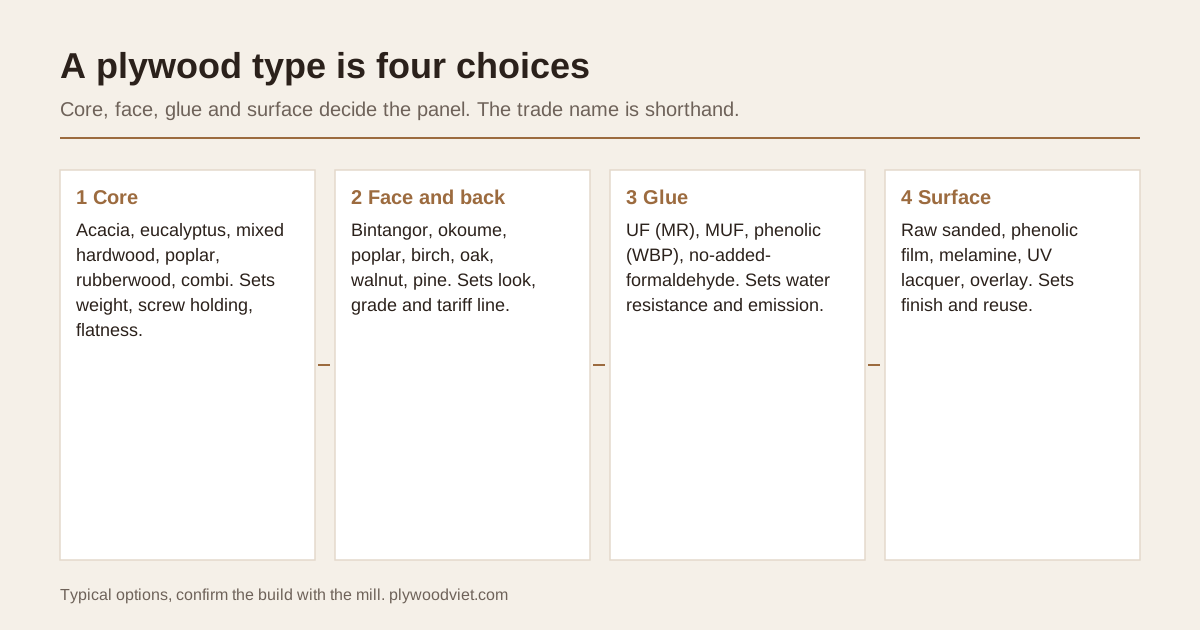
A plywood type is a recipe of four choices: what the core is made of, what veneer or overlay sits on the face, which glue holds the plies together and what finish goes on top. Vietnam mills press most panels on plantation acacia and eucalyptus cores, so the type is usually decided by the face, the glue and the surface. This page sorts the common types into one matrix and links to the detail page or guide for each.
| Choice | Common options in Vietnam | What it decides |
|---|---|---|
| Core | Acacia, eucalyptus, mixed hardwood, poplar, rubberwood, combi | Weight, screw holding, flatness, price |
| Face and back | Bintangor, okoume, poplar, birch, oak, walnut, ash, pine | Look, paint finish, tariff line, price |
| Glue | UF (MR), MUF, phenolic (WBP), soy or other no-added-formaldehyde resin | Water resistance, emission, use class |
| Surface | Raw sanded, phenolic film, melamine paper, UV lacquer, overlay | Ready-to-use finish, reuse, wear |
Two panels with the same trade name can differ on all four lines. That is why a quote for “commercial plywood 18 mm” says almost nothing until the core, face, glue and surface are written down.
The type matrix
The table lists the types Vietnam mills quote under their usual trade names. Columns show the typical build. Rules to check are the ones a buyer usually meets for that type, not a full list.
| Type | Typical core | Typical face | Typical glue | Surface | Rules buyers usually check | Detail |
|---|---|---|---|---|---|---|
| Commercial plywood | Acacia, eucalyptus or mixed hardwood | Bintangor, okoume, poplar | MR (UF) or WBP | Raw sanded | Emission class of the market, tariff line by face species | Grades guide |
| Film faced plywood | Eucalyptus, acacia or mixed hardwood | Phenolic film, 120 to 440 g/m2 per face | WBP phenolic or MUF | Film, sealed edges | Bond test, US scope wording on phenolic film panels | Film faced plywood |
| Hardwood and decorative plywood (US sense) | Veneer core, sometimes MDF or particleboard | Hardwood or decorative veneer | UF, MUF or no-added-formaldehyde resin | Raw, UV or other coating | TSCA Title VI, US trade remedy scope, HP-1 grade | Hardwood plywood |
| Birch faced plywood | Acacia or eucalyptus | Imported birch veneer | MR, MUF or WBP | Raw or UV | Veneer origin, face grade | Birch faced plywood |
| Furniture or cabinet grade | Full hardwood, calibrated | Okoume, birch, poplar or fancy veneer | E1 or lower emission UF or MUF | Raw or UV | Formaldehyde certificate of the market | Furniture grade guide |
| UV prefinished plywood | Hardwood core | Poplar, birch, okoume or fancy veneer | Low emission UF or MUF | UV-cured lacquer | Formaldehyde, coating scope in US trade case | Face veneer guide |
| Melamine faced plywood | Hardwood core | Melamine paper on both faces | MR or MUF | Melamine | Emission of core and paper | Melamine guide |
| Packing plywood | Lower grade mixed core | Lower grade face | MR (UF) | Raw | Usually none on the panel itself; ISPM 15 is not required for plywood | Packing guide |
| Structural plywood | Species named by the standard | Grade named by the standard | Phenolic, exterior bond | Raw, stamped | PS 1, AS/NZS 2269 or JAS structural | Structural guide |
| Marine plywood | Okoume or other listed species, no voids | Okoume or similar | WBP phenolic | Raw | BS 1088 | BS 1088 guide |
| HDO and MDO overlay | Hardwood core | Resin-impregnated overlay paper | WBP phenolic | Overlay | Bond test | Overlay guide |
| LVL and block board | Parallel veneers or timber strips | Veneer | MR or WBP | Raw | Use class and grading for the market | LVL guide |
| Thin and bendable plywood | Poplar, acacia or other thin veneer | Poplar, birch or fancy veneer | UF or MUF | Raw | Formaldehyde for furniture use | Thin plywood |
| Fire-retardant plywood | Hardwood core | Any | Treated glue line or treated veneer | Raw | Fire test standard of the market | Fire-retardant guide |
| Trailer and container flooring | Dense hardwood core | Hardwood | WBP phenolic | Film or coating, often treated | Treatment rules, axle and load specs | Flooring guide |
The table is a map, not a catalogue. It does not say that any particular mill presses each type. PlywoodViet passes one specification to up to three mills that already press that build.
How the four choices interact
Core first. Most Vietnam panels use plantation acacia or eucalyptus veneer in the core. Eucalyptus is usually the denser of the two. A combi core mixes species or grades and cuts weight and cost at the price of screw holding. Rubberwood and poplar cores appear in furniture and thin panels. The core sets weight per sheet, which decides how much fits in a container under the payload limit, covered in plywood weight per sheet.
Face second. The face sets the look and, in several markets, the tariff line. Customs nomenclature splits heading 4412 by the species of the outer plies and by whether every ply is 6 mm or thinner, so an okoume face, a birch face and a bintangor face on the same core can enter under different lines with different duty. The HS code 4412 guide shows how the split works.
Glue third. Glue decides where the panel can live. Urea formaldehyde (often sold as MR) is for dry interiors. Melamine-fortified urea (MUF) moves up in water resistance. Phenolic resin (sold as WBP) is the exterior bond for formwork, flooring and marine use. Glue also drives formaldehyde emission, which is regulated by market: TSCA Title VI in the United States, the REACH limit in the EU, F-star grades in Japan. The trade names are compared in MR, melamine or WBP, and the class names in E0, E1, E2 and F4-star.
Surface last. A film, a melamine paper, a UV lacquer or an overlay turns a panel into a ready product. The surface never hides the panel under it: a weak core shows through a thin film as dips on the concrete, and a patched face shows through a clear UV coat.
Trade names that mean different things in different markets
Some names travel badly between markets. Three cause the most confusion.
| Name | What a Vietnam mill usually means | What the buyer’s market may mean |
|---|---|---|
| Hardwood plywood | Any panel with a hardwood veneer core | US rules: an interior decorative panel under TSCA Title VI; the 2026 trade case scope covers panels with a hardwood, softwood or bamboo face or back |
| Commercial plywood | Paint-grade panel, often bintangor face | In some markets, any non-structural plywood |
| Marine plywood | Exterior glue, okoume face | BS 1088 panel with species, void and bond limits |
When the buyer’s market uses a legal definition, write the definition into the enquiry, not the trade name. The hardwood plywood page shows the three US definitions side by side.
Grades are a separate axis
A type says what the panel is made of. A grade says how good the face and back are. Vietnam mills quote commercial grade pairs such as BB/CC or B/BB. The US uses HP-1 letters and numbers, Europe uses EN 635 classes and structural standards have their own grade stamps. The same type can be sold in several grades, and the grade pair is the second line of any order after the type. See plywood grades explained and the EN 635 face classes.
How to write the type into an enquiry
Use five lines, one for each choice plus the size:
- Core: species, full hardwood or combi, ply count for the thickness
- Face and back: species, grade pair, rotary or sliced
- Glue: glue family and the emission requirement of the destination, with the test method
- Surface: raw, film weight per face, melamine, UV or overlay, and which side
- Size and thickness: sheet size, nominal thickness and tolerance
Put the destination in the same message. It decides which formaldehyde rule, which legality file and which duty questions apply, and the export market pages set those out by country.
PlywoodViet is a matching service. It does not press plywood and does not certify any mill or panel. Send the five lines through the enquiry form and up to three Vietnam mills that press that build will quote.
Frequently asked questions
How many types of plywood are there?
There is no fixed list. A plywood type is a combination of four choices: core, face, glue and surface. Trade names such as commercial, film faced or packing plywood are shorthand for common combinations. Read the four choices behind the name before you compare two quotes.
Which type of plywood is strongest?
Strength depends on core species, ply count, veneer quality and bond, not on the trade name. A full hardwood core with an exterior phenolic bond and no core gaps is the strong end of what Vietnam mills press. For a load-bearing use, name the structural standard of your market and ask for the test report.
Is marine plywood a separate type?
Marine plywood is a panel built to a named standard, usually BS 1088, with limits on species, voids and bond. A panel called marine without the standard is a sales name. See the BS 1088 guide before you order.
Does the type decide the import rules?
Partly. Face species and ply thickness decide the tariff line, the face and the intended use decide whether formaldehyde rules apply, and the destination decides the rest. The export market pages set out the rules country by country.
Sources
- Wikipedia: Plywood (construction, veneer and adhesive types)
- Federal Register via GovInfo: hardwood and decorative plywood from Vietnam, final dumping determination with scope (21 July 2026)
- eCFR: 40 CFR part 770, formaldehyde emission standards for composite wood products
- Japan Customs: tariff schedule chapter 44 (heading 4412 split by species and ply thickness)
Rules, standards and data are cited as references, not as claims about PlywoodViet or any mill. Confirm the current text and status with the issuing body.
Need a quote for this panel?
Send the specification. We match you with up to 3 Vietnam mills and answer within 24 business hours.
Get matched with a mill