Guides / Specification
Formwork Plywood Reuse: What Sets the Number of Pours and How to Count It
October 13, 2026
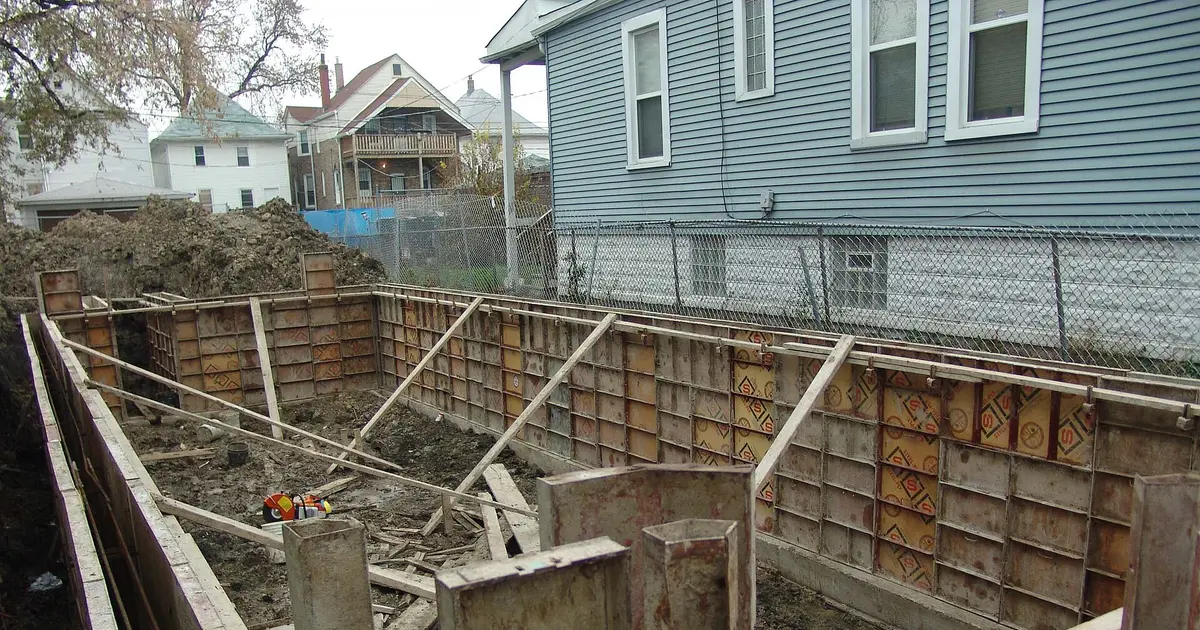
A formwork panel does not wear out all at once. It loses its face at the corners first, takes water at the edges next and then swells, lifts and stops giving a clean finish. Somewhere in that process the panel is finished as formwork, and the number of pours it gave is the figure that decides what it really cost.
Quotes offer reuse numbers freely. A mill that says 20 pours and a mill that says 8 may be describing the same panel on different sites.
What reuse depends on
Reuse is the result of seven inputs. A panel that is strong on all seven lasts. A panel that is weak on one fails at that point.
| Input | What it controls | Where it is covered |
|---|---|---|
| Film or overlay weight | Surface wear and water barrier | Film weight 120 vs 220 g/m2 |
| Glue | Whether edges hold when wet | MR, melamine or WBP glue |
| Core | Stiffness, nail holding, gap marks | Acacia or eucalyptus core |
| Edge sealing | Water entry at the weakest point | Edge sealing plywood |
| Release agent | Clean strip, less film damage | Site practice |
| Handling | Dents, cuts, dropped corners | Site practice |
| Concrete mix and finish | Abrasion, pour height, vibration | Project |
Most quotes address the first two. The last three belong to the site and can swing the result by a factor of two.
Typical reuse ranges
These are typical ranges under reasonable handling with sealed edges and a release agent. They are indications and not guarantees.
| Panel type | Typical pours | Note |
|---|---|---|
| Plain plywood, MR glue, no film | 1 to 3 | Not suited to formwork beyond the first pours |
| Light film, 120 g/m2, WBP glue | About 3 to 6 | Cost-driven jobs |
| Standard film, 220 g/m2, WBP glue, hardwood core | About 8 to 15 | The common working spec |
| Heavy film or overlay, 440 g/m2 or HDO, WBP glue | About 15 to 30 or more | Heavy reuse, fair faced concrete |
| Overlay with coated edges and steel reinforced frames | Higher, depends on system | Engineered systems |
A number above these ranges can happen on a site with excellent control. A number below them happens often, when edges are left raw and panels are stripped with crowbars. Heavier overlay grades such as HDO sit at the top of the range and have their own specification.
What cuts reuse short
Seven causes recur.
- Raw edges. Water enters the end grain, the core swells and the film lifts at the border.
- Unsealed nail holes and cuts. Each one is a path for water, and each cut made on site is a new raw edge.
- No release agent, or too little. Concrete sticks, and stripping tears the film.
- Steel crowbars on the face. Dents and cuts open the film.
- Dropped panels. Corners crack and edges lift.
- Long exposure to sun and rain between pours, which dries and wets the panel repeatedly.
- Wrong glue. MR glue gives out at the edges after a few wet cycles, regardless of film.
The first three cost almost nothing to fix. A can of edge sealer, a spray of release agent and a rule about crowbars add pours at no extra panel cost.
Fair faced concrete shortens reuse
When the concrete surface is architectural, the panel retires early on purpose. A panel that is perfectly fine for a hidden wall is not fine for an exposed face, because small marks in the film, a lifted corner or a worn patch print onto the concrete.
Contractors who build exposed work often use a fresh or near-new panel for each exposed pour, and move used panels to hidden work. The reuse number that counts for the exposed face may be two or three pours, and the same panel then serves another ten on hidden work. A good plan counts pours by use class and not as a single number for the whole stock.
Pour rate and form pressure
Fresh concrete presses outwards like a liquid, and the pressure rises with the pour rate and the pour height. A slow pour of a low wall puts little load on the panel. A fast pour of a tall column puts a lot, and the panel flexes between supports.
Three practical points follow.
- Deflection leaves marks. A panel that bows under load leaves a bulge, and repeated bowing weakens the core.
- Vibration adds load. Poker vibrators increase the pressure for a short time and can damage a face at the contact point.
- Joints open. A flexing panel opens the seam and lets paste out, which marks the panel edge.
Formwork guides such as the ACI and CIRIA documents give pressure formulas. Your designer picks thickness and support spacing from them, and the panel must meet that minimum thickness in the field.
Storage between jobs
A formwork panel loses pours while it waits. Four rules limit the damage.
- Clean first. Remove dried cement while it is still fresh, with plastic tools.
- Oil lightly. A thin film of release oil on the face keeps the panel from sticking to the next one in the stack.
- Stack flat, on a level base off the ground, with a cover on top and open sides for air.
- Seal exposed cuts before storing.
Panels left in the sun, uncovered, dry out and curl. Panels left in the rain swell at the edges. A tidy yard is part of the reuse figure.
Repair and retirement
Small damage is cheap to fix and large damage is a sign to retire the panel.
- Patch small film damage with a repair kit or a resin filler, then sand flush and seal.
- Reseal edges each time a panel is cut or chipped.
- Trim damaged borders and use the cut-down panel in a smaller module, where the border has less effect.
- Retire a panel when the edge swells noticeably above the face, when the film is lifting over a large area or when the core is soft to a screwdriver.
A simple rule works on many sites. If a panel leaves a mark you would reject on the concrete, move it down to a hidden use. If it cannot do hidden work either, retire it and record the pour count.
Reuse accounting for rental and contractor stock
A contractor who owns a large formwork stock needs a real reuse figure for budgeting. The calculation has three parts: the purchase price of each batch, the pours recorded and the cost of repairs and labour. Dividing total cost by total pours gives a figure per pour for each supplier and each grade.
This number is worth more than any brochure. A supplier whose panels give 12 pours in your log and who charges 10 per cent more than a supplier giving 8 pours is the cheaper choice. Share the figures with the mill. A mill that sees real data improves its product, and a mill that does not want to see it tells you something.
Counting cost per pour
Price per sheet is only half of the cost. A better figure is price per pour.
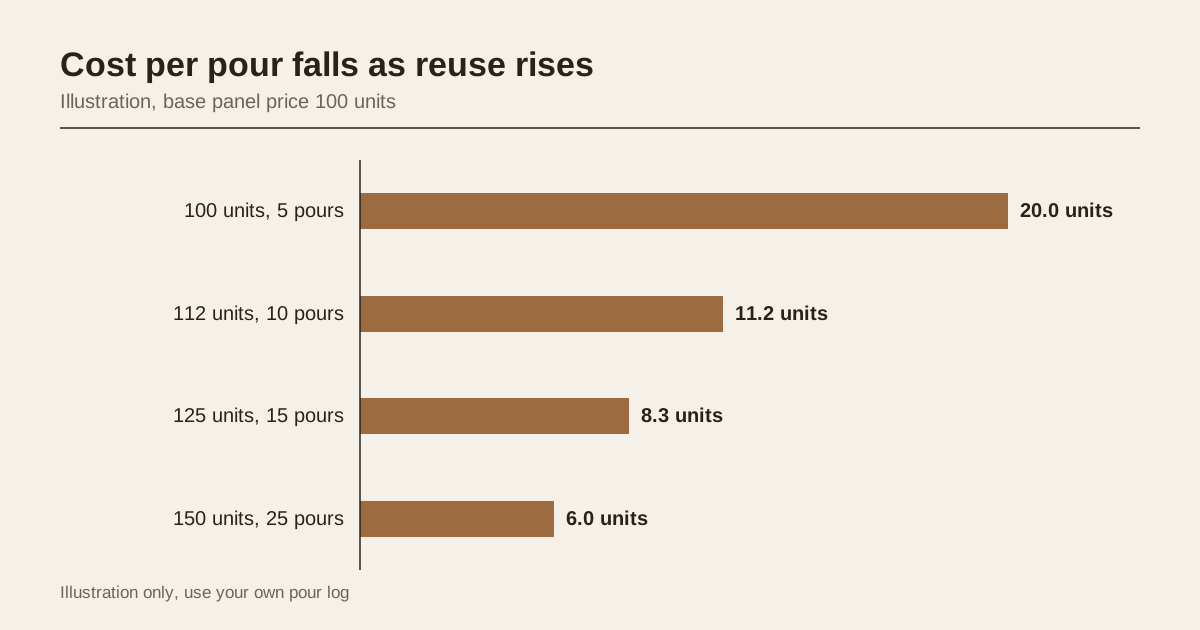
Take a base panel price of 100 units. The table shows the effect of reuse on cost per pour.
| Panel price, units | Pours achieved | Cost per pour |
|---|---|---|
| 100 | 5 | 20.0 |
| 112 | 10 | 11.2 |
| 125 | 15 | 8.3 |
| 150 | 25 | 6.0 |
A dearer panel is cheaper per pour as long as the extra reuse is real. The calculation breaks if the site wastes pours with poor handling, since a heavy film that is damaged on the first strip has the cost per pour of a light film. Spend on edge sealing and handling first, and on film weight second.
Add the labour too. Each pour needs time to set and strip the panel, and a panel that needs patching or cleaning costs more labour per use. Cheap panels often cost more labour.
Keeping a pour log
The best way to know your own numbers is to write them down. A simple log has five columns.
- Panel batch or pallet number
- Date and pour
- Condition after stripping: good, light wear, edge damage, replace
- Repairs made: edge seal, patch
- Final pour count when the panel is retired
After a few hundred panels, the log gives a real reuse figure for each product from each mill. That figure beats any brochure, and it is the strongest argument when you negotiate or change supplier.
Trial loads and acceptance
Before a large order, buy a trial load and use it on a real pour sequence. Check five things.
- Surface after the first pour. Smooth, no film lift, no core marks on the concrete.
- Edge condition after the first strip and after the fifth.
- Thickness spread across a pallet, since uneven panels leave steps in the concrete.
- Flatness, especially on thin panels and long spans.
- Dimensions against the order, using the tolerance rules in plywood sizes and tolerance.
Take photos at each stage, with a tape measure and the panel label in the frame.
Formwork design basics
Panel choice is one part of the system. Panel thickness, span and support spacing set deflection under concrete pressure.
- Thicker panels span further between supports, but cost more and weigh more.
- Closer supports allow thinner panels and give a flatter finish.
- Pour rate and height raise the pressure on the form, and fast, tall pours need stronger systems.
- Joints between panels need tight, sealed seams or the concrete leaks and marks.
Your formwork designer sets thickness and spacing, and the panel supplier provides a panel that meets the declared thickness and stiffness. Asking for the minimum thickness in the order protects the design. Bond tests that suit formwork are covered in plywood bond tests: boil, soak and shear.
Writing it into the order
- Panel size, thickness and tolerance
- Film or overlay weight per face, and supplier
- Glue type with the bond test standard
- Core description, with no gaps under the film
- Edge sealing, two coats, all four edges
- Packing that keeps panels dry
- A trial load before the main order
Closing checklist
- Plan reuse by site handling, not by brochure
- Seal every cut edge and nail hole on site
- Use a release agent before every pour
- Strip with soft tools
- Log every panel and every pour
- Compare mills by cost per pour from your own log
Send the pours you need and the finish you want through the enquiry form, and up to three Vietnam mills will quote against the same specification.
Frequently asked questions
How many times can formwork plywood be reused?
As a typical range, a light film panel gives a handful of pours, a standard film faced panel with phenolic glue gives about 8 to 15 under careful handling, and a heavy overlay panel can give more. These are not promises. Handling, release agent, edge sealing and concrete finish change the number a great deal.
What is the biggest cause of early formwork failure?
Water entering at unsealed edges and nail holes, followed by damage during stripping. Once the core swells or the film lifts at the edge, the panel degrades quickly. Edge sealing and gentle stripping add more pours than a heavier film does.
How should I compare formwork panels from different mills?
Compare cost per pour and not price per sheet. Divide the panel price by the number of pours you can realistically expect under your handling, and ask each mill what the panel looked like after the number of pours it claims. Buy a trial load before a large order.
Need a quote for this panel?
Send the specification. We match you with up to 3 Vietnam mills and answer within 24 business hours.
Get matched with a mill