Guides / Specification
Phenolic Film Weight: What 120 and 220 g/m2 Change in Use and in Cost
October 11, 2026
Film faced plywood is sold on a few numbers. Panel thickness, glue type and film weight are the main three. Thickness and glue are easy to check. Film weight is the one that most often hides behind a catalogue phrase, and it decides how the face behaves on the third, the tenth and the twentieth pour.
The basic ladder of 120, 220 and 440 g/m2 is set out in film faced plywood from Vietnam. This article goes one step further. It looks at what a heavier film does on a job, how to check what you were sold and how to decide whether the step from 120 to 220 g/m2 pays.
What the film is
The film is a sheet of paper impregnated with phenolic resin. It goes on the panel face under heat and pressure, where the resin flows, bonds to the veneer and cures into a hard, smooth, brown or black skin. The skin does three jobs:
- Water barrier. It keeps water out of the face veneer.
- Wear surface. It resists abrasion from concrete, steel and handling.
- Release surface. It lets the concrete come away cleanly with a smooth finish.
Film weight is the mass of this layer per square metre, counted for one face. A heavier film has more paper and more resin, so the skin is thicker and harder. A lighter film is thinner and wears through sooner.
What 120 and 220 look like on a site
| Behaviour | 120 g/m2 | 220 g/m2 |
|---|---|---|
| Surface wear | Wears through at corners and high spots early | Holds longer, wears more evenly |
| Water barrier | Pinholes and scratches let water in sooner | Better, scratches stay shallower |
| Concrete finish | Good at first, degrades as film wears | Good for longer |
| Cleaning | Scrapes can cut through film | Tolerates scraping better |
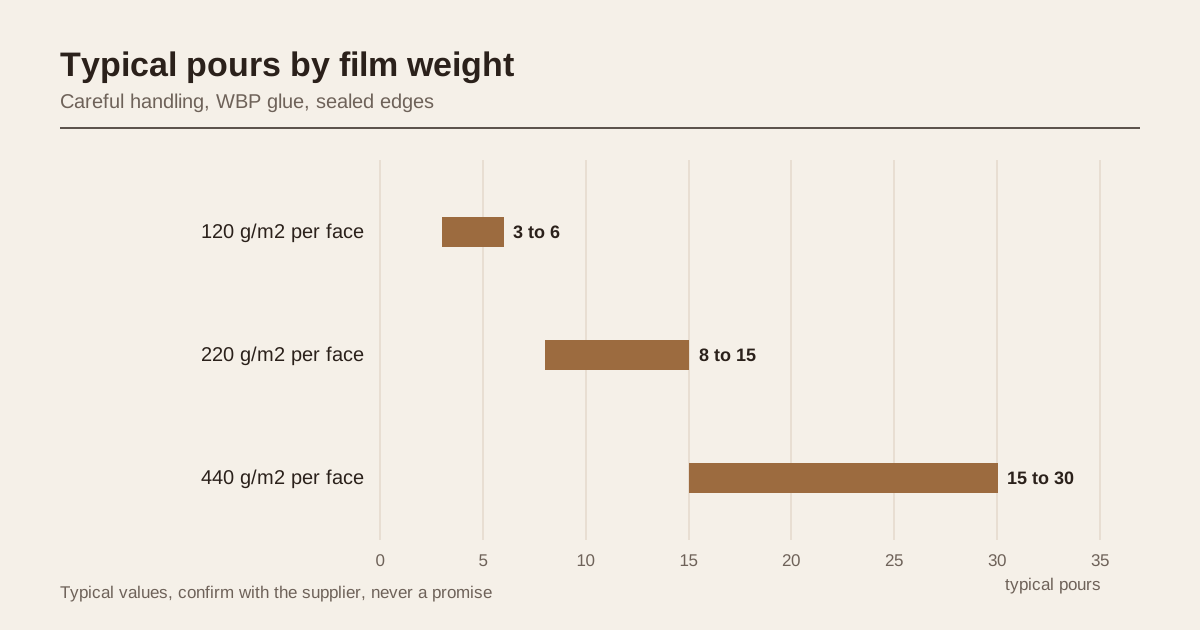
| Typical reuse, light conditions | About 3 to 6 pours | About 8 to 15 pours |
| Typical price position | Lower | Higher, often a modest step |
The reuse figures are typical ranges under careful handling, with sealed edges and a release agent. They are not promises. A badly handled panel with a heavy film can fail before a well handled panel with a light film. For the broader reuse picture see formwork plywood reuse cycles.
Where a light film makes sense
A 120 g/m2 film is often the right product, and it is not always a compromise.
- Single or few uses, such as a one-off slab or a small job with no reuse planned
- Hidden concrete surfaces where finish does not matter, such as foundations and retaining walls
- Low-cost projects where the plan is to scrap panels after a handful of pours
- Non-formwork uses, such as wall panels, shop fittings, signage or flooring underlay, where the film is a surface and not a working skin
Paying for 220 g/m2 when the panel will be used three times is wasted money. A 120 g/m2 film on a panel with good glue and a sound core, used three times, beats a heavy film on a weak panel.
Where a heavy film pays
The heavier film earns its cost when the panel will be reused or when the finish counts.
- Repeated pours on a site with many floors and a fixed formwork system
- Fair faced concrete where marks from worn film show on the wall
- Abrasive mixes, such as concrete with sharp aggregate or a high cement content
- Rental or contractor stock that moves from job to job
- Handling-heavy sites where panels are stripped by crowbar and stacked on rough ground
On the question of overlay grades beyond film, such as heavy industrial overlays used for long reuse, see the specification choices in plywood grades explained.
The cost per pour way of looking
A better way to compare is cost per pour, not price per sheet. Take a panel at a base price of 100 units. If it gives 5 pours, each costs 20 units. A panel at 112 units that gives 10 pours costs 11.2 per pour. A panel at 125 units that gives 15 pours costs about 8.3 per pour. The heavier film costs more per sheet and less per pour.
The calculation only holds if the reuse figures are real. A heavy film that is damaged on the first pour by a bad stripping method has the same cost per pour as a light film. Spend on handling and sealed edges before you spend on film weight, because those two protect whatever film you buy.
How film weight is checked
You cannot see film weight from the outside. Four checks help.
- Supplier data sheet. The film manufacturer prints weight, resin content and pressing recommendations. Ask the mill for the data sheet of the film on your panel.
- Roll labels. Film rolls carry labels with the weight and the supplier. A photo of rolls in the mill, with labels visible, is a reasonable request.
- Edge thickness comparison. At a chipped corner or a cut edge, the film layer shows as a thin dark line. Compare with a reference sample of a known weight.
- Laboratory weighing. A lab can weigh a film sample stripped from a cut piece. It is the most direct check, and it is worth doing on a first order.
A mill that cannot give you any of these is giving you a number with no source.
Per face or total
The most common confusion is per face or total. A quote for “220 g/m2 film” may mean 220 g/m2 on each face or 220 g/m2 summed across both faces, which is 110 on each. The difference is a factor of two, and only one reading is the heavier film you thought you bought.
Write “per face” into the order. If the faces differ, give both numbers. Some panels use a heavy film on the working face and a lighter one on the back, which is a reasonable way to save money and should be stated.
How the film goes on, and what goes wrong
The film is pressed onto a sanded base, often in a second hot press, at a platen temperature in the region of 130 to 140 °C. The resin in the paper melts, flows into the veneer surface and cures. A good bond needs the right temperature, time and pressure for the film grade, and a clean, dry, flat base.
Common film defects are easy to spot on a sample.
| Defect | What it looks like | Usual cause |
|---|---|---|
| Pinholes | Tiny dots where the film did not close | Dust or moisture on the base, or low resin flow |
| Bubbles | Raised blisters under the film | Trapped steam or wet base |
| Wrinkles | Folds or creases | Film laid unevenly, or the film is too light for the panel |
| Edge lift | Film peeling at the border | Poor bond at the edge, or damage in trimming |
| Colour streaks | Uneven shade | Resin flow variation or mixed film batches |
A defect on a fresh panel is a defect for every pour that follows. Pinholes let water in from the start, and a lifted edge catches on a crowbar. Check samples under a low light, and put a limit on defects per square metre in the order.
Brown film and black film
Colour causes endless arguments and says little. Brown and black films are both phenolic. Black film usually has a heavier carbon or dye content and looks more uniform, and brown films show the paper and resin more clearly. Some buyers believe black is stronger. Strength follows from the paper weight, the resin content and the bond, not from the colour.
If the colour matters, for site marking or brand reasons, write it down. If it does not matter, do not pay a premium for it. Ask the same questions of both: weight, supplier, data sheet.
Care on site extends the film
A heavy film on a badly treated panel wears like a light one. Four site habits protect the film you paid for.
- Apply a release agent before every pour, in a thin, even coat and wipe pools away.
- Strip with care. Plastic wedges and soft-faced tools protect the film better than steel crowbars.
- Clean without scraping. A soft brush or a plastic scraper removes dried cement. A steel scraper cuts the film.
- Seal fresh cuts and nail holes. Every cut edge and every hole is a path for water, and a dab of edge sealer closes it.
These habits cost almost nothing, and they decide whether a panel reaches the top of the reuse range or the bottom.
Film and the rest of the panel
Film weight is one input. The panel under it counts at least as much.
- Core. A gap under the film marks the concrete and weakens the film over time. A gap-free hardwood core is part of the spec.
- Glue. A panel with MR glue delaminates at the edges even under a heavy film. WBP phenolic glue is the minimum, as described in MR, melamine or WBP glue.
- Edge sealing. Water enters at the edge first, and a sealed edge keeps the core sound, as in edge sealing plywood before export.
- Pressing. A film pressed with the wrong temperature or time can look right and peel early.
Writing it into the order
- Film weight in g/m2, per face, and the film supplier or grade
- Colour, if it matters for site marking
- Glue type, core description and ply count
- Edge sealing method and coats
- Thickness tolerance and sheet size
- Sample panel approved before production starts
Closing checklist
- Match film weight to the number of pours planned
- Calculate cost per pour and not only price per sheet
- Write per face into the order
- Ask for the film data sheet and roll labels
- Check core, glue and edge sealing before upgrading the film
- Approve a sample from the production line
Send the film weight and the planned pours through the enquiry form, and up to three Vietnam mills that press film faced panels will quote for the same specification.
Frequently asked questions
What does film weight in g/m2 mean?
It is the weight per square metre of the resin-impregnated paper pressed onto the panel face. A heavier film has more paper and more resin, so it forms a thicker, harder, more water resistant skin. Always ask whether the figure is per face or the total for both faces.
Is 220 g/m2 film twice as good as 120 g/m2?
Not in a simple way. The heavier film lasts longer under abrasion and water, and the gain depends on the core, the glue, the edge sealing and how crews handle the panels. Treat the film weight as one input to reuse and not as a multiplier.
How can I check the film weight I was sold?
Ask for the film supplier's data sheet and the roll labels, and compare the film thickness at a chipped edge or corner with a reference sample of known weight. A laboratory can also weigh a stripped film sample. A quote that gives only the word heavy or standard does not state a weight.
Need a quote for this panel?
Send the specification. We match you with up to 3 Vietnam mills and answer within 24 business hours.
Get matched with a mill